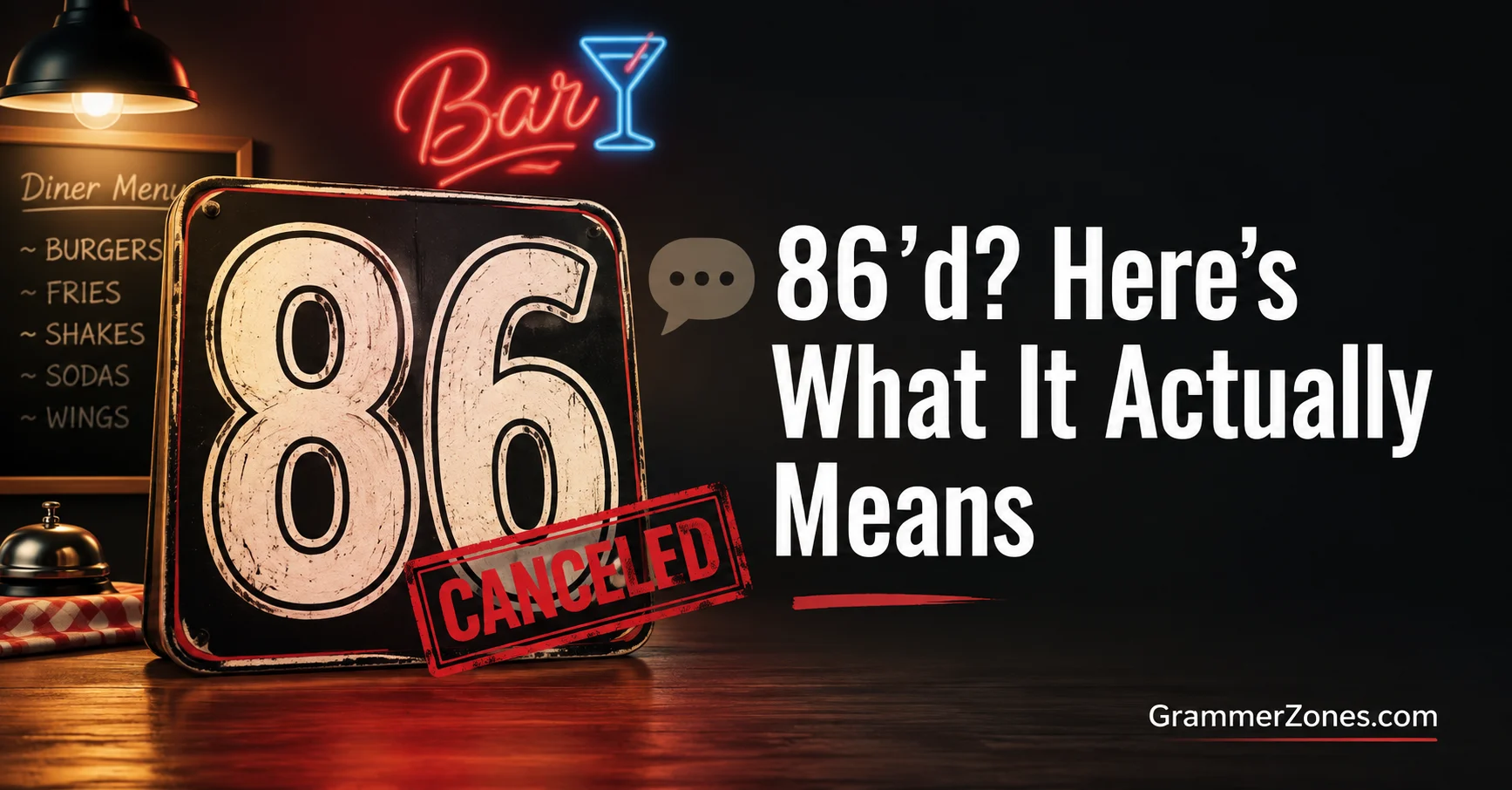
Short answer first, because you’re probably mid-scroll: 86 means to get rid of something, cancel it, or refuse it a sold-out menu item, a bad plan, a person you’re done dealing with. It started in restaurant kitchens nearly a century ago and has since worked its way into texting, TikTok captions, dating-app horror stories, and even police and military slang, though not always accurately.
Here’s the thing about 86 almost everyone has heard it, but almost nobody can explain where it came from with any confidence. That’s exactly why it keeps trending as a search term.
It shows up in a chef’s shout, a breakup post, a crime drama, and a group chat, and it doesn’t always mean the same thing twice. This guide untangles the actual history, the industries that use it differently, and the newer, internet-driven meanings that have piled on top of the original so you’re not left guessing the next time someone drops it on you.
So What Does 86 Actually Mean?
Strip away the context, and 86 is a verb. It means to eliminate, discard, refuse, or cancel full stop. What changes is the object of that verb.
A cook uses it to mean we’re out. A bouncer uses it to mean this person isn’t welcome anymore. A friend texting you uses it to mean forget the plan. And in darker corners of gaming forums, crime fiction, and true-crime commentary threads, people stretch it to mean something closer to kill which isn’t the historical meaning, but has become a real, if grim, secondary usage online.
Green’s Dictionary of Slang, one of the more rigorous references for tracing English slang over time, lists eighty-six back to at least the 1930s American food-service scene, defined essentially as to refuse to serve or to eject. That’s a useful anchor: whatever the term has picked up since, its working-class, industry-floor roots are well documented, not just internet folklore.
Where Did 86 Come From? The Competing Theories
Ask ten people where 86 originated and you’ll get ten different, half-confident answers. None of them is fully proven, and that’s worth saying plainly rather than picking a favorite and presenting it as settled fact.
The most commonly cited theory traces it to diner and soda-fountain shorthand from the 1920s and ’30s, when kitchen staff used numbered codes to communicate fast during a rush. Under this account, 86 simply meant an item was unavailable, practical, unglamorous, born out of the need to talk over a busy line without slowing service down.
A more colorful, harder-to-verify story ties the phrase to Chumley’s, a former Prohibition-era speakeasy at 86 Bedford Street in Greenwich Village. As the legend goes, when a police raid was coming, staff would tell patrons to 86 it, meaning leave through the door at that address, since the main entrance was watched. It’s a great story. It’s also the kind of story that tends to get repeated more because it’s memorable than because it’s confirmed, and etymologists who’ve looked into it generally treat it as folklore rather than documented fact.
A third, less-cited theory connects 86 to old rhyming slang, where numbers or nonsense phrases stood in for other words in this case, possibly rhyming loosely with nix, an older term for canceling or refusing something.
The honest conclusion, and the one most slang historians land on: the diner-code theory has the strongest documentary support, the Chumley’s story is beloved but unproven, and the true origin may never be pinned down with certainty. If you’re looking for a tidy, single answer, this term won’t give you one and that’s part of its appeal.
How 86 Gets Used, Depending on Where You Hear It
Context does most of the heavy lifting with this word, which is exactly why it can trip people up.
In a working kitchen, it’s routine, almost boring. 86 The halibut just means the kitchen ran out, nobody’s upset, nobody’s reading into it. Bar and club staff use it slightly differently: he’s 86’d means someone has been cut off or banned, sometimes for a night, sometimes for good, depending on what happened.
Outside hospitality, the word has loosened up considerably. People now use it for almost anything they want to kill off an idea in a meeting, weekend plans that fell through, a wardrobe choice that didn’t work out. We 86’d the Saturday trip after the weather forecast reads as completely normal in casual speech now, with zero connection to restaurants.
On Reddit, threads asking whether the term is still used or just an old boomer thing pop up periodically, and the honest answer from most commenters, especially those currently or previously in food service, is that it’s alive, common, and shows no sign of fading. If anything, its meaning has expanded rather than shrunk.
86 in Texts, DMs, and Group Chats
Digital communication took the restaurant meaning and ran with it, mostly in the direction of cancel or forget it.
Texted between friends, 86 it usually functions the same way as never mind or scrap that quick, low-stakes, no explanation required. On Instagram, it shows up in captions about cutting people or habits loose: 86’d that friendship in 2024 and don’t regret it. TikTok has two lanes for restaurant workers explaining kitchen slang to a curious audience, and a completely separate wave of people using it emotionally, as in 86 the people who don’t show up for you.
That split is worth noticing. The term is doing double duty right now: it’s still literal industry jargon in one context and emotional shorthand in another, and which one you’re looking at usually depends on whether the person posting has ever worked a restaurant shift.
Police Slang, Military Use, and the 86 47 Mashup
This is where a lot of the more serious-sounding searches land, so it’s worth being precise instead of vague.
Is 86 an official police code? Not really. It shows up informally in some law enforcement and CB radio slang to mean something or someone has been removed from a situation, but it isn’t a standardized code the way the actual 10-codes (10-4, 10-20, and so on) are. Usage varies by department, region, and even by individual officers treating it as borrowed civilian slang that made its way into casual radio chatter, not an official designation you’d find in a training manual.
What about the military? Similar story. 86 gets used informally in some military and tactical circles, and heavily in military-inspired fiction and gaming, to mean eliminating a target or scrapping an operation. It’s closer to slang picked up from broader American English than a term unique to military communication.
And 86 47? This one is almost entirely an internet-culture mashup rather than an established phrase from any official context. It typically pairs 86 (eliminate) with 47, a number heavily associated with weapons culture and fictional assassin lore, most recognizably the AK-47 and the video game character Agent 47. You’ll mostly see it in gaming communities and meme threads, layered slang built on top of older slang, rather than a phrase with any formal history behind it.
Worth noting too: there’s no standardized use of 86 in physics, medicine, or aviation terminology. If you’ve come across it in one of those contexts, it’s almost certainly a one-off, team-specific, or in-joke usage rather than an industry standard, the kind of thing worth double-checking with whoever used it before assuming it’s a recognized term.
Getting the Misconceptions Out of the Way
A handful of assumptions about this term get repeated so often they start to sound like fact, so it’s worth correcting them directly.
It doesn’t always mean something violent; most real-world uses are mundane, tied to menu items or canceled plans, not anything dramatic. It also isn’t a recent, internet-born invention; it predates social media by roughly eighty years, with roots in Depression-era diner culture. And despite what a quick search might suggest, there’s no single confirmed origin story. The Chumley’s tale is popular precisely because it’s a good story, not because it’s been verified.
Words That Mean Something Similar
A few terms live in the same neighborhood, each with its own shade of meaning:
- Nix closest in spirit, meaning to reject or cancel something outright.
- Scrap used for abandoning a plan, project, or idea before it’s finished.
- Cut off applies specifically to people, much like 86’ing someone from your life.
- 86’d / sold out the original, literal restaurant meaning, still in daily use in food service.
- Bounce someone bar and club slang for physically removing a person.
- Ghost a modern cousin, though it implies disappearing without explanation rather than an active decision to remove someone.
The difference between 86 and most of these alternatives comes down to intent. Ghosting is passive and often unexplained. Blocking is a platform-specific digital action. Canceling, in its pop-culture sense, usually involves public fallout. 86’ing someone, by contrast, is a direct, deliberate call you decided, and it’s done.
How to Respond When Someone Says It
The right reaction depends entirely on context, and reading that context correctly matters more than the word itself.
If a server tells you the dish is 86’d, there’s nothing to overthink, just pick something else off the menu. If a friend texts that plans are 86’d, a quick confirmation (got it, rain check?) is all that’s needed. If someone tells you they 86’d a person from their life, it’s usually not an invitation to debate the decision, it’s more of an emotional update than a discussion starter. And if you come across the term used in a way that sounds genuinely threatening rather than figurative, don’t assume it’s just slang context and tone matter, and it’s fine to take concerning language seriously rather than brushing it off as internet talk.
86 on Dating Apps and in Modern Dating Slang
Dating culture has adopted this word with real enthusiasm. I 86’d him after he canceled our third date has become a fairly standard way to describe cutting someone off for flakiness, bad behavior, or one too many red flags. It fits neatly into a broader pattern where dating-app users borrow short, blunt service-industry language to describe relationship fatigue, ghosted, benched, and now 86’d all serve a similar purpose: compressing a messy, often frustrating decision into one clean, final-sounding word. Its appeal on dating apps specifically is that it doesn’t invite follow-up questions. Something got 86’d. That’s usually the whole story.
Where This Leaves You
86 has managed something most slang doesn’t: staying useful for nearly a hundred years while constantly picking up new territory.
It started as a fast, practical way for kitchen staff to talk over a busy shift, and it’s now doing everything from ending group chats to describing bad dates to showing up loosely, informally in police and military slang.
What hasn’t changed is the core idea. Something is unavailable. Someone isn’t welcome anymore. A plan is off the table. However it’s dressed up in a given context, 86 almost always means the same simple thing: this is done, and it’s not coming back.
Next time you hear it behind a bar, in a text, or buried in a meme you’ll know exactly which version you’re looking at, and how to answer it.

I’m Olivia Cruz, a content writer at grammerzones.com, specializing in clear, user-friendly blog posts on grammar and modern slang meanings. I focus on simplifying complex terms including drug and gang slang into accurate, easy-to-understand content.