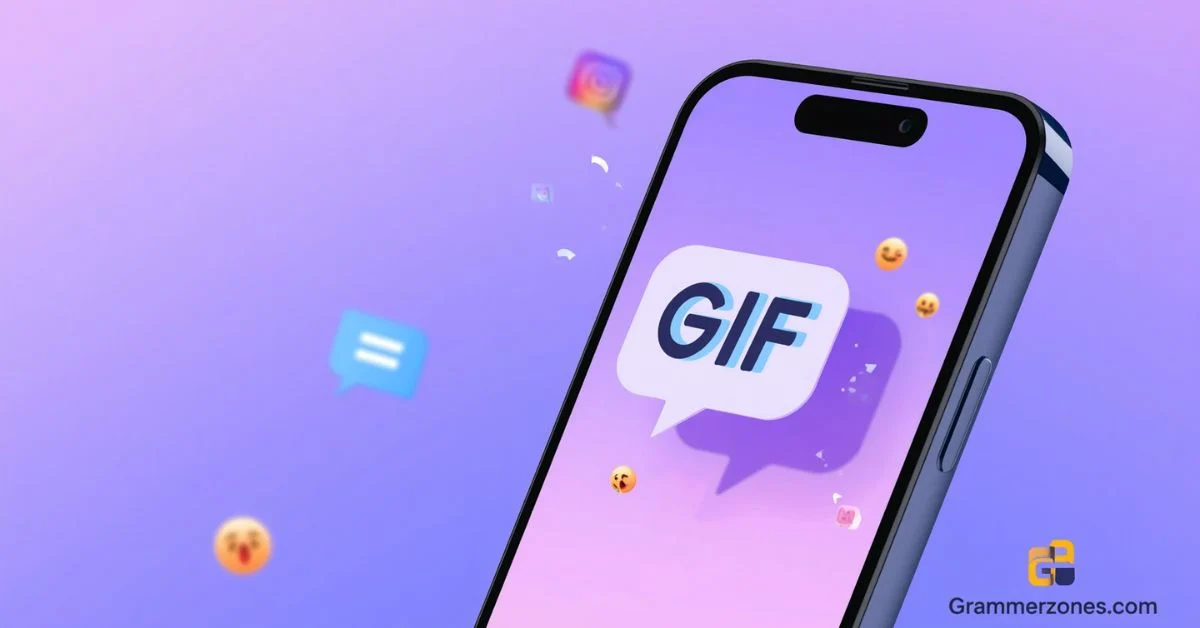
A GIF is a short, looping animated image but when someone sends you one in a text, on WhatsApp, or in a dating app, it’s rarely about the file format at all. It’s shorthand for a reaction: laughter, sarcasm, excitement, or sometimes flirtation.
The actual meaning depends almost entirely on the image itself and the conversation it lands in.
You know the moment. You send a message, and instead of a reply, you get a spinning cat, a shrugging cartoon, or someone from a movie throwing their hands up in disbelief. No words. Just a GIF. And now you’re the one left decoding it. Is that funny? Sarcastic? Are they into me, or just bored?
That confusion is exactly why so many people end up typing what GIF means from a girl or gif slang meaning into Google at 11 p.m. It’s not that anyone’s forgotten what a GIF technically is. It’s that GIFs have quietly become their own dialect, a visual shorthand that says more than the caption ever could, and most of us are just improvising our way through it.
This guide breaks down what a GIF actually is, where it came from, how its meaning shifts across WhatsApp, Instagram, and TikTok, and more usefully how to actually respond when one shows up in your inbox and you have no idea what it means.
So What Does GIF Actually Stand For?
GIF stands for Graphics Interchange Format, a compressed image file that can hold multiple frames and loop them automatically, with no sound. That’s the textbook definition, and it hasn’t changed since the format was invented.
But nobody Googles gif meaning because they want a computer science lesson. They want to know why their crush just sent them a dancing raccoon. And that’s the split worth understanding: GIF has a literal meaning (a file type) and a social meaning (an emotional stand-in), and almost every search around this topic is really about the second one.
Think of it like emoji, but with a personality upgrade. An emoji gives you one static face. A GIF gives you a whole performance: a specific expression, a pop-culture reference, a punchline all compressed into two seconds of looping video. That’s a lot more communicative than 😂, which is exactly why GIFs took over group chats the way they did.
Where the GIF Actually Came From
The format was created in 1987 by Steve Wilhite, an engineer at CompuServe, back when the internet was slow enough that even a small looping image counted as an achievement. It wasn’t built for jokes or flirting, it was built to make basic web graphics load faster.
For roughly two decades, that’s all it was: a technical file format, mostly invisible to average users. The shift happened when Tumblr, and later GIPHY and Tenor, made GIFs searchable. Once people could type eye roll or mind blown and instantly pull up a matching clip, the GIF stopped being a background technology and became a language one word, one clip at a time.
One detail that still causes arguments decades later: Wilhite always insisted it should be pronounced jif, like the peanut butter. Most of the internet disagrees and says it with a hard G. Neither side is backing down, and honestly, that ongoing, slightly ridiculous debate says a lot about how much personality this little file format has picked up along the way.
What a GIF Means Depends on Where You Get It
The emotional job of a GIF stays roughly the same everywhere react, add tone, fill a silence but the flavor shifts by platform.
In WhatsApp, a GIF is usually a full reply on its own. If someone sends one instead of typing something back, it generally means they read your message, had a reaction to it, and couldn’t be bothered (or didn’t need) to put that reaction into words. It’s efficient, not dismissive.
On Facebook, GIFs show up most in comments and Messenger threads, often doing the job of sarcasm or celebration in group conversations, the kind of tone that’s genuinely hard to convey in a plain comment without it reading flat.
On Instagram, especially in DMs and Story replies, GIFs work like instant, low-effort reactions the animated version of tapping a heart, except with a lot more personality packed in.
In regular texting and TikTok comments, GIFs lean heavily comedic. They’re less about deep meaning and more about landing a joke faster than a sentence could.
Across all of it, the underlying rule is the same: a GIF is a shortcut. It says in one loop what would otherwise take a paragraph and that’s precisely why it’s become such a fixture in how people actually talk to each other online.
Does GIF Mean Anything Different in Physics, Medicine, or Aviation?
Short answer: not really. Outside of internet culture, GIF almost always just refers to the same image compression format used the same way in a scientific presentation as it is in a group chat, just with a chemistry diagram instead of a meme.
You’ll occasionally see GIF used as a one-off internal abbreviation in a specific hospital, lab, or engineering document, but that’s not a recognized standard term in medicine or aviation it’s localized shorthand, not an industry-wide acronym, and it has no real connection to the internet slang usage. If you’ve landed here searching for a medical or aviation-specific meaning, the honest answer is that one probably doesn’t exist you’re almost certainly looking for the chat/slang definition instead.
The Biggest Misconceptions About GIF Meaning
A few myths keep circulating, so it’s worth clearing them up directly.
Myth: A GIF always means something romantic.
It doesn’t. Most GIFs are jokes, reactions, or filler not secret signals. Context (what was said right before it) matters far more than the fact that a GIF was sent at all.
Myth: GIF and meme mean the same thing.
Not quite. A meme is a broader cultural concept or joke; it can be a screenshot, a video, a phrase, anything. A GIF is specifically the moving, looping file format that often carries a meme, but not every meme is a GIF, and not every GIF is a meme.
Myth: crowd-sourced slang dictionaries define correct usage.
Sites where anyone can submit a definition are entertaining, but they tend to skew toward the funniest or most exaggerated submission rather than how people actually use GIFs day to day. Treat those entries as comic relief, not a reliable reference.
GIF vs. Similar Terms
It helps to know where GIF sits next to its closest relatives:
- Meme the broader joke or cultural reference; a GIF is often the delivery method for one
- Sticker app-specific reaction images (common on WhatsApp and Telegram), which may be static or animated
- Emoji a single static symbol, simpler and more universal than a GIF
- Boomerang a short looping video clip, popularized by Instagram, functionally similar but technically different from a GIF
The easiest way to keep them straight: if it moves and loops silently, it’s a GIF. If it has sound, it’s a video clip pretending to be one.
How to Actually Respond When Someone Sends You a GIF
This is usually the part people actually came for, so here’s the practical version:
- If it’s clearly a joke, match the energy. A reaction, a laughing emoji, or a GIF back keeps the exchange going.
- If it feels flirty, look at what was said right before it, not the GIF in isolation. A playful clip after a compliment often does signal interest, but a random funny GIF mid-conversation usually doesn’t carry that weight on its own.
- If it’s replacing an actual answer some people default to GIFs when they don’t know what to say. A light acknowledgment (lol accurate or okay that’s fair) usually moves things along better than overanalyzing it.
- If you’re genuinely lost just ask. Haha what does this mean 😅 is a completely normal response and usually gets you a straight answer.
The short version: don’t treat a GIF like a puzzle to solve. Read the sentence before it, not the animation itself, and you’ll almost always land on the right interpretation.
GIFs in Dating Apps and Everyday Conversations
This is where GIF slang gets debated the most. On apps like Hinge, Tinder, or Bumble, a well-timed GIF can do more for a conversation than a paragraph of text; it signals humor, confidence, and that you’re not taking the small talk too seriously.
But here’s the part worth remembering: a random, absurd GIF, a duck smoking a cigarette, Elmo standing in a burning room is almost never a coded message. It’s a mood, not a riddle. These kinds of chaotic, self-aware clips are popular precisely because they’re relatable shorthand for this is a mess or I’m not okay but it’s funny, not because they’re hiding some deeper meaning.
The pattern holds outside dating apps too. Unless a GIF is paired with clearly romantic or emotionally loaded text, the simplest explanation is usually correct: someone saw something funny or relatable and wanted to share the feeling faster than typing could.
Frequently Asked Questions
What does GIF mean in a text message?
Almost always a reaction to something you said, sent, or did used in place of writing out a response.
What does GIF mean from a guy or a girl specifically?
There’s no gendered difference in what a GIF means. Context and the specific clip matter far more than who sent it.
How do you pronounce GIF?
Both gif (hard G) and jif (soft G, as the creator intended) are widely used; there’s no universally agreed-upon correct pronunciation.
Is a GIF the same as a meme?
No. A meme is the broader joke or reference; a GIF is the animated file format that often delivers one.
Conclusion
Here’s the honest takeaway: GIF technically means Graphics Interchange Format, but that’s the least useful part of the answer.
The meaning you’re actually looking for why that GIF, from that person, at that moment comes from context, not definition.
Look at what was said right before it. Consider the platform, the relationship, and the tone of the conversation so far.
Nine times out of ten, the answer becomes obvious once you stop staring at the animation and start rereading the sentence that came before it.
GIFs aren’t a secret code to crack, they’re just a faster, funnier way of saying something that plain text was too slow to express.
Discover More Posts!
- What Does CD Mean? Slang, Dating, Banking & Tech Explained
- DM Meaning Decoded: From Instagram DMs to Diabetes Mellitus
- ATM Slang Meaning: What It Really Means in Texts & Chats

I’m Mason Reed, a language and communication writer at GrammerZones.com. I specialize in explaining English meanings, grammar concepts, internet slang, texting abbreviations & social media terms in a clear and practical way. My goal is to provide accurate, easy-to-understand content that helps readers confidently navigate modern language and online communication.