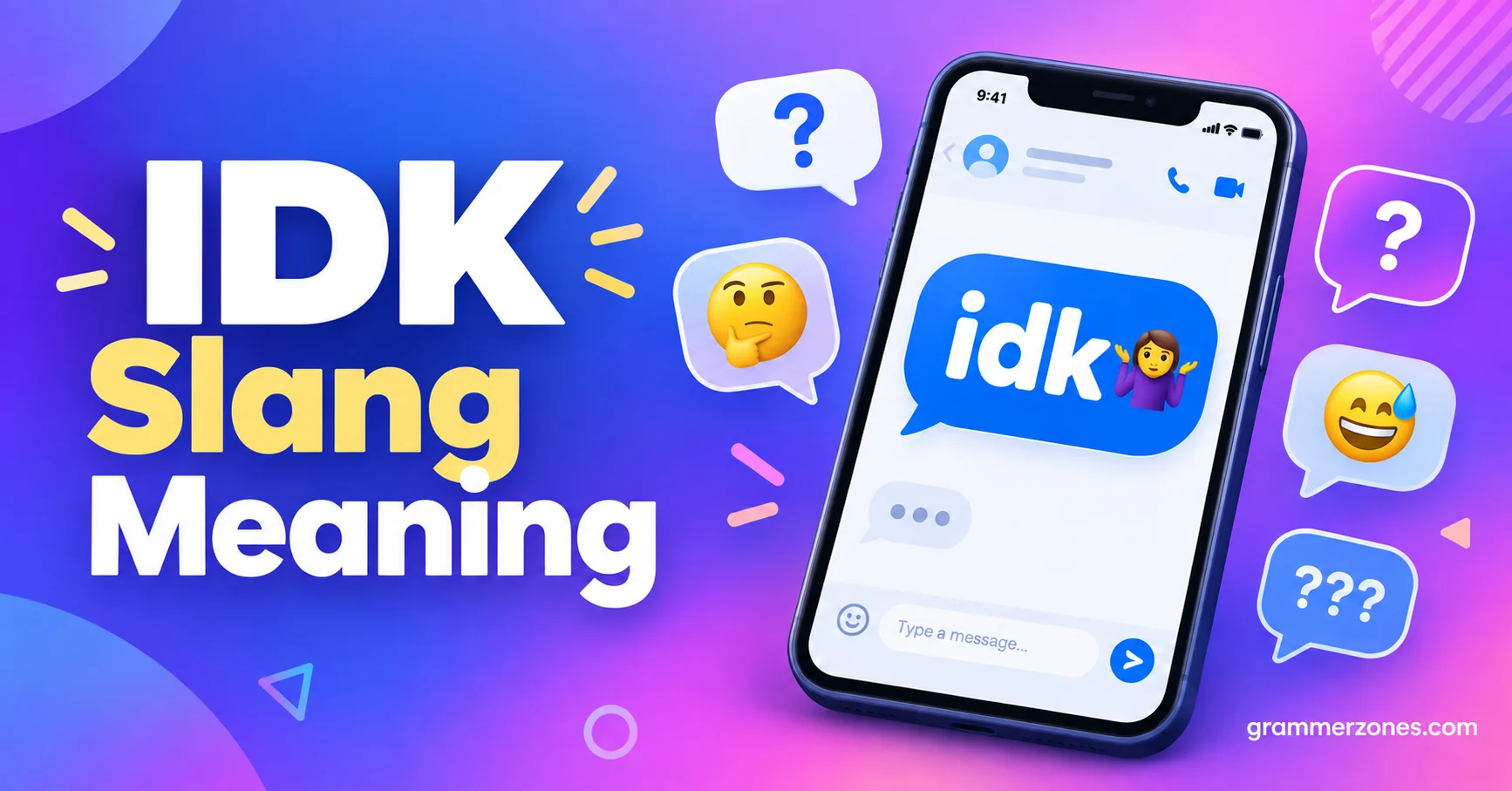
IDK is short for I don’t know. People use it in texts, DMs, and comments when they’re unsure, don’t have an answer, or don’t want to commit to one. That’s the whole definition, but there’s more to it.
You’ve probably seen a message like idk land on your screen and wondered If the sender was clueless, bored, or quietly annoyed. Three little letters can carry all of those moods, depending on the punctuation, the timing, and who sent it.
That gap between the dictionary meaning and the real tone is why so many people search for the idk slang meaning. They want to know what it stands for, how to read it, when to use it, and how to reply without making things awkward.
This guide covers all of that in plain language: what IDK means, where it came from, how it behaves on WhatsApp, Instagram, and TikTok, what it does on dating apps, and how it differs from lookalikes like IDC and IDGAF.
Meaning and Definition of IDK
IDK is an acronym (technically an initialism, since you say the letters one by one: eye-dee-kay). It stands for I don’t know. It belongs to the big family of internet slang and texting slang that grew up with chat rooms, SMS, and social media.
Most of the time it does one of three jobs:
- A genuine lack of knowledge. Someone asks, What time does the match start? and you reply, idk, check the app. You simply don’t have the answer.
- A soft maybe or I haven’t decided. Want pizza tonight? idk, maybe. Here it signals uncertainty rather than ignorance. You’re leaving the door open.
- A low-effort or evasive answer. When someone asks a question they’d rather not deal with, idk can work as a polite shrug that ends the topic.
Notice that the same three letters produce very different feelings. That’s why context and tone matter more than the definition. Linguists call this pragmatics, meaning how words work in real situations rather than on paper. A friendly idk 😅 sounds relaxed. A flat, lowercase idk. after a serious question can sound cold.
You’ll also see it in longer phrases: idk what to do, idk man, idk about that, and the popular idk lol. Dictionaries such as Merriam-Webster and Oxford recognize it as informal shorthand, and it’s so common that many people write idk without thinking of it as an acronym anymore. It has become a word of its own, closer to dunno than to a code you have to decode.
Background and Origin
The idk slang meaning makes more sense once you know why these shortcuts exist. Early internet users, especially in chat rooms, IRC channels, and instant messengers like AOL Instant Messenger and MSN Messenger, typed on slow connections and clunky keyboards. Shorter messages meant faster conversations. Abbreviations like LOL, BRB, and IDK spread because they saved time and signaled that you belonged to the online crowd.
Mobile phones pushed this further. Early SMS plans limited messages to 160 characters, and many people paid per text. Typing idk instead of I don’t know was a small saving that added up. Even after unlimited plans arrived, the habit stuck, because it had become part of how people sound online.
There’s also a social reason. Informal spelling and abbreviations tell the reader, This is a relaxed conversation. Using idk with a friend feels natural, while writing I do not know can feel stiff, even a bit dramatic. Language researchers who study digital communication often describe abbreviations like this as tone markers, not just shortcuts.
Exact first-use dates are hard to pin down. Informal chat leaves few records, and the phrase I don’t know has always had spoken shortcuts like dunno and I dunno. What we can say confidently is that IDK became widespread through 1990s and 2000s online chat culture and has been a staple of Gen Z and Millennial texting ever since. Today it appears everywhere from group chats to social media captions, and it needs no explanation for most people under 40.
Usage in Different Contexts
Where you use IDK changes how it lands. Here’s a practical breakdown.
Casual conversation with friends. This is IDK’s natural habitat. idk what to wear, idk if I can come, and idk, you decide all sound completely normal between peers.
Group chats. In a group, idk often means I have no strong opinion. When people plan dinner or weekend outings, it usually nudges someone else to make the call.
Social media comments and captions. People use it for humor and mood: idk why this song hits so hard. Here it works as a relatable, unpolished voice, which performs well on platforms that reward a human tone.
Professional settings. This is where you need to be careful. In a work email, a client message, or a message to a manager, idk can read as careless. Compare:
- ❌ idk, I’ll check.
- ✅ I’m not sure yet. Let me check and get back to you by 3 p.m.
The second version shows honesty and ownership, which is how trust gets built at work. Even on relaxed workplace tools like Slack, many teams accept idk among peers but expect fuller wording when talking to leadership or customers.
Formal writing. Essays, reports, applications, and official documents should avoid it entirely. Write I do not know or, better, This information is not currently available.
A simple rule: match the formality of the person you’re talking to. If they write casually, IDK is fine. If they write in full, polished sentences, mirror that.
IDK Meaning in Chat, WhatsApp, Instagram, and TikTok
The core meaning stays the same everywhere, but each platform adds its own flavor.
Text messages and iMessage. Short and direct. idk answers a question quickly. Adding a period (idk.) often makes it sound blunt or irritated, while adding lol or an emoji softens it.
WhatsApp. Because WhatsApp is used for family chats, friend groups, and even small business, IDK shows up across many relationship types. Between friends it’s casual. With relatives or older contacts, some people prefer I’m not sure to avoid sounding dismissive. Voice notes are common on WhatsApp too, so people will sometimes say eye-dee-kay out loud, which shows how deeply the term has become spoken language.
Instagram. In DMs, replying idk to a Story reaction or a question sticker is common and low-pressure. In comments, it’s often playful: idk who needs to hear this 😂. In captions, it can express a mood, a shrug, or a deliberately vague vibe.
TikTok. IDK appears constantly in comments, on-screen text, and captions. Creators use it to sound relatable (idk why I’m crying at this), and viewers use it as a reaction (idk but I’m obsessed). Often it carries no real uncertainty and works as a casual filler that gives a video a confessional, unscripted feel.
Snapchat and Discord. Fast, informal chats mean IDK is used almost as punctuation. In Discord servers, it’s frequently paired with other slang like ngl and fr.
Across all of these, tone lives in the details: capital letters (IDK! can sound frustrated), stretched-out versions (iiidk), and emojis like 🤷 or 😅 all shift the message. When in doubt, read the surrounding messages, not just the three letters.
Meaning in Physics, Medical, and Aircraft Terminology
Since people often search for this, here’s the honest answer: IDK has no formal, standard meaning in physics, medicine, or aviation. It’s everyday internet slang, not technical vocabulary. Anyone claiming otherwise is guessing.
Physics. Physics uses symbols, units, and named constants, and IDK isn’t one of them. If you see it in a physics forum or a student’s notes, it almost certainly means I don’t know how to solve this. In scientific culture, what we don’t know yet is actually a respected statement, because it marks the edge of current research. It just isn’t written as IDK in papers.
Medical. Healthcare relies on strict abbreviations, and safety guidelines push clinicians to avoid ambiguous ones. Slang like IDK doesn’t belong in patient records, prescriptions, or handoff notes. You might notice similar-looking medical abbreviations, such as IDDM (insulin-dependent diabetes mellitus), but they’re unrelated. If a health professional says they don’t know something, the professional standard is to say so clearly and then arrange tests or a referral. For any medical question, rely on a qualified professional, not an internet abbreviation.
Aircraft and aviation. Aviation communication follows standardized phraseology so nothing gets misunderstood. Pilots and controllers use precise terms such as unable, negative, say again, and standby rather than casual shorthand. There’s no official aviation use of IDK, and clear, standard wording is a safety requirement there.
So if you searched for a hidden technical meaning, the reassuring answer is that IDK stays the same in every field: informal shorthand for I don’t know. Professionals in these fields may casually text it to friends, but it doesn’t appear in their official language.
Common Misconceptions About IDK
Because IDK is so short, people read a lot into it. Here are the most common myths.
Myth 1: IDK always means the person doesn’t care. Not true. Someone can care deeply and still not know the answer. idk what to do about my job often signals stress, not indifference. That’s a big difference from IDC (I don’t care).
Myth 2: IDK means they’re ignoring me. Sometimes it’s a short reply because the person is busy, typing on the go, or unsure how to phrase a longer answer. Judge the pattern over several messages, not one.
Myth 3: IDK is rude. It can sound rude in formal or serious situations, but among friends it’s usually neutral. Rudeness comes from tone and context, not the acronym itself.
Myth 4: IDK is only for teenagers. People of all ages use it. Adults use it in casual texts every day, though many switch to not sure in professional contexts.
Myth 5: IDK always means the person is lying or hiding something. Occasionally idk is used to dodge, but it’s far more often honest. Treating every idk as suspicious can hurt relationships.
Myth 6: IDK is grammatically wrong. Slang isn’t wrong, it’s informal. Language experts generally see abbreviations like this as a natural, evolving part of digital communication.
The best habit is to read IDK as a clue rather than a verdict. Look at the timing, the emojis, the punctuation, and the relationship. If a reply worries you, you can simply ask, Everything okay? or Want to talk about it? A short, kind follow-up clears up more confusion than any decoding guide.
Similar Terms and Alternatives to IDK
If you want variety, or you need something more polished, there are plenty of alternatives.
Close relatives (same don’t know family):
- IDRK: I don’t really know. Slightly more honest about partial uncertainty.
- IDEK: I don’t even know. Often shows confusion or overwhelm.
- IDKY: I don’t know why.
- Dunno / dunno lol: A spoken-style version.
- No clue and beats me: Casual, friendly alternatives.
- Not sure: Neutral and safe almost anywhere.
Terms people often confuse with IDK:
- IDC: I don’t care.
- IDGAF: A stronger, ruder version of IDC.
- IDTS: I don’t think so.
Other texting staples you’ll see alongside it: TBH (to be honest), NGL (not gonna lie), FR (for real), IMO/IMHO (in my opinion), SMH (shaking my head), LOL, and OMG.
More professional alternatives:
- I’m not certain about that.
- I don’t have that information yet.
- Let me look into it and get back to you.
- I’d need to confirm before answering.
Emoji alternatives: 🤷, 🤷♀️, 🤷♂️, 🤔, 😅, and 🙃 all suggest uncertainty without a single word.
Choosing between them is about tone. IDRK sounds more thoughtful than IDK. Not sure it sounds calmer. Let me find out what sounds helpful and responsible. Picking the right phrase for the moment makes you a clearer communicator, both online and off.
How to Respond to IDK
Your best reply depends on why the person said it. Start by reading the situation.
If they truly don’t know: Help them move forward.
- No worries! Want me to look it up?
- That’s okay, we can figure it out together.
If they’re being indecisive (dinner, plans, outfits): Offer a simple choice, since open questions can feel overwhelming.
- Want Italian or sushi?
- Okay, I’ll pick, and you can veto.
If they seem upset or withdrawn: Check in gently instead of pushing.
- You seem a bit off. Want to talk?
- No pressure, I’m here whenever.
If they’re being playful: Match the energy.
- idk either 😂
- Honestly the same.
If they gave a vague answer to an important question: Stay calm and ask again, kindly.
- I get that it’s tricky. Could you think about it and tell me tomorrow?
At work: Respond with clarity and a next step.
- No problem. Who might know? I can follow up with them.
A few smart habits help. Don’t reply with sarcasm (wow, helpful) unless you’re joking with a close friend. Don’t assume the worst. And if an idk answer keeps blocking a conversation that matters, move it to a call or an in-person chat, where tone is easier to read. Text strips out voice and face, and IDK is one of those short replies where a bit of real communication can make a big difference.
Differences Between IDK and Similar Words
The three letters look alike, but the meaning changes a lot with one letter swapped.
IDK vs. IDC. IDK means you lack knowledge. IDC means you lack concern. idk where we’re eating says you haven’t decided. idc where we’re eating says any option is fine. Mixing them up can accidentally sound uncaring.
IDK vs. IDGAF. IDGAF is the harsher cousin of IDC, and it can sound aggressive or dismissive. IDK is mild by comparison. Use IDGAF carefully, and never in professional messages.
IDK vs. IDRK. IDRK (I don’t really know) suggests you know a little but not enough. It’s more precise and often sounds more sincere.
IDK vs. IDEK. IDEK (I don’t even know) adds emotion. It’s what you say when something has left you baffled.
IDK vs. I don’t know in full. The full phrase feels more serious, formal, or emphatic. Compare idk (light) with I don’t know. (heavy). The spelled-out version, especially with a period, can suggest sadness or frustration.
IDK vs. Maybe. Maybe leaning toward possibility. IDK leans toward uncertainty. Idk, maybe combines both and is a very common softener.
IDK vs. No idea / No clue. These sound a bit stronger and more final about lacking information.
IDK vs. TBH or NGL. These aren’t about knowledge at all. They introduce honesty (to be honest, not gonna lie), so they often appear right next to IDK: ngl, idk what I want.
Understanding these differences protects you from misunderstandings, especially with new friends, new partners, or colleagues, where one wrong letter can change the message.
Relevance in Online Conversations and Dating Apps
On dating apps like Tinder, Bumble, and Hinge, small words carry big signals, and IDK is a good example.
When it’s harmless. Early on, idk, I’m open to anything that works as a relaxed answer to Where should we meet? It can suggest an easygoing personality.
When it can hurt. Repeated idk replies to every question can look like low effort or low interest. Imagine someone asks, What are you into? and you answer idk. The conversation stalls, and the other person may feel they’re doing all the work.
How to use it well. Add a little detail. Instead of idk, try idk, maybe something outdoorsy? What about you? That version admits uncertainty but keeps the conversation moving, which is what dating chats need.
Reading it to someone else. If a match answers idk once, don’t panic. If it becomes the pattern, that’s useful information about their interest or communication style. A friendly nudge such as I’d love to hear what you think can invite a better response.
Trust and honesty. Speaking honestly about big topics, like idk if I want kids yet, is far better than pretending. Uncertainty stated openly builds trust. Using idk to dodge every serious question, however, can create confusion later.
Beyond dating. In online communities, gaming chats, and forums, IDK works the same way: fine as a quick reply, weak as a whole contribution. The healthiest online conversations mix short, casual replies with real engagement.
Conclusion
IDK is one of the simplest and most useful pieces of modern slang. It stands for I don’t know, it grew out of early internet chat and text messaging, and it now lives in every corner of digital life, from WhatsApp and Instagram to TikTok and dating apps.
The key point is that its meaning depends less on the letters and more on the situation. A relaxed idk between friends is nothing to worry about. A cold idk. in the middle of an important talk may deserve a gentle follow-up. In professional settings, a clearer phrase like I’m not sure yet, but I’ll find out almost always sounds better.
Remember, too, that IDK has no special technical meaning in physics, medicine, or aviation. It’s an informal shorthand everywhere. Once you understand how it differs from IDC, IDGAF, IDRK, and IDEK, you can read messages more accurately and write your own with better tone.
The next time someone sends you idk, take a beat and look at the context before deciding what it means. A little attention to tone, timing, and relationship turns three letters into real understanding.
Discover other Posts!
Rap Slang Decoded: Meanings, Origins & How to Use It Right
FFR Meaning: The One Guide That Actually Explains Every Version
TBH Slang Meaning: What It Really Means in Texts 💬

I’m Mason Reed, a language and communication writer at GrammerZones.com. I specialize in explaining English meanings, grammar concepts, internet slang, texting abbreviations & social media terms in a clear and practical way. My goal is to provide accurate, easy-to-understand content that helps readers confidently navigate modern language and online communication.


1 thought on “IDK Slang Meaning: What It Really Says When You Text It”