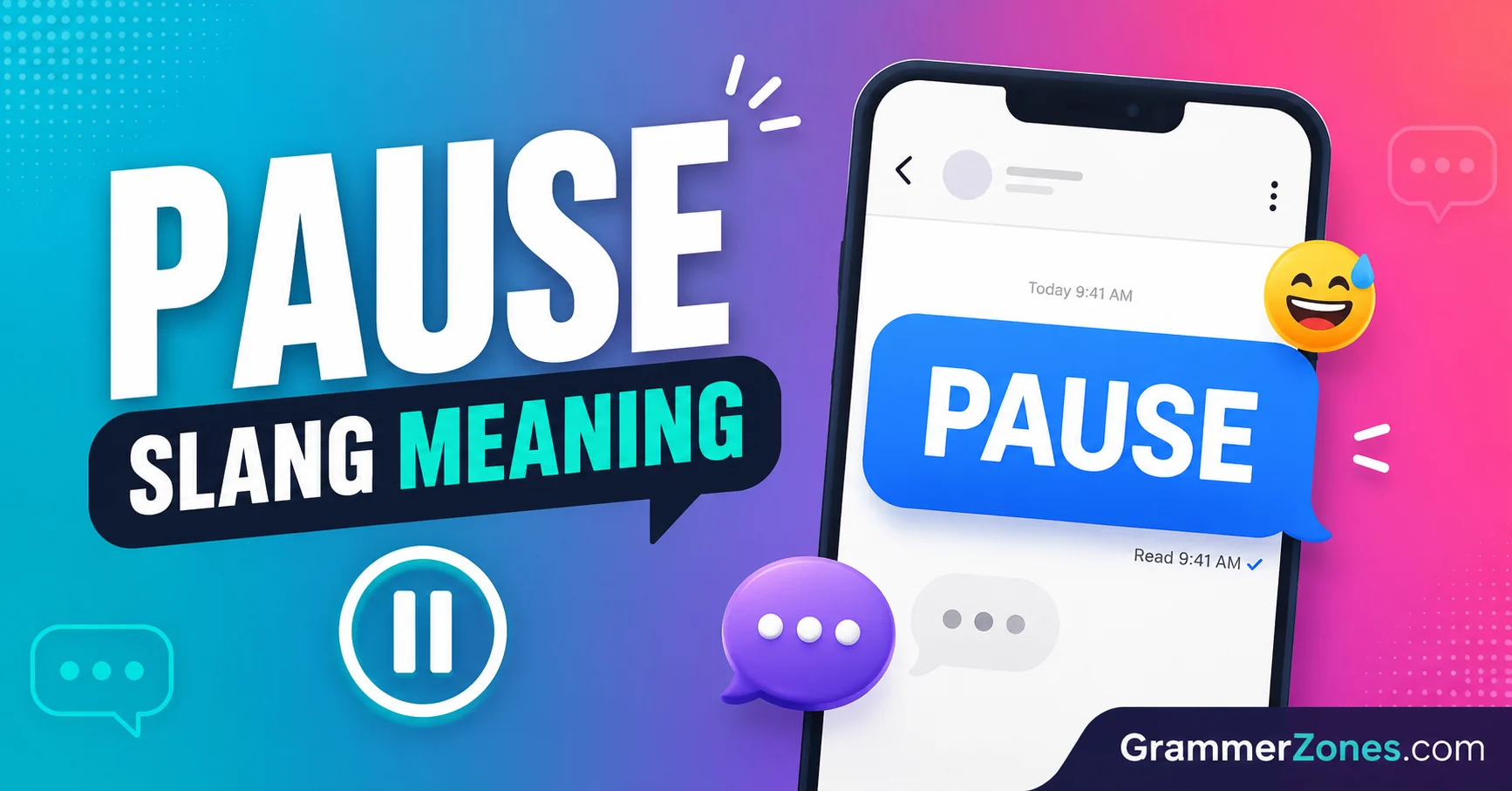
Quick answer: When someone says pause after a sentence, they’re flagging that what they just said accidentally sounded suggestive or gay-sounding. It’s a verbal do-over, basically the spoken version of hitting undo. That’s the short version.
The longer version involves a Vine-era joke format, a genuine debate about if the phrase is homophobic, and a handful of copycat terms that get confused with it constantly.
Why This Word Keeps Confusing People
Here’s a scene that plays out a hundred times a day on TikTok and in group chats: someone says something completely normal, it comes out sounding a little off, and within seconds someone replies with a single word pause. No explanation. Everyone else in the thread just laughs and moves on like nothing happened.
If you weren’t already in on the joke, that’s genuinely confusing. You know what pause means you press it on a remote. So why does typing it after a sentence turn into a whole social moment?
That gap between the literal word and its slang use is exactly why so many people end up searching for pause slang meaning. Some are trying to figure out if they just got roasted. Some want to know if the term is actually offensive before they use it themselves. And a fair number land here by accident, having typed pause meaning while actually looking for something else entirely more on that mix-up later, because it trips up search results constantly.
What Pause Actually Means as Slang
Strip away the meme culture and the definition is fairly simple: pause is said (or typed) right after a comment that unintentionally sounded sexual or romantic, usually between two men, as a way of retroactively canceling out the implication. It’s reactive, not planned. Nobody sits down and decides to say it. It just fires off the second a sentence takes an unexpected turn.
Search Urban Dictionary for pause slang meaning and you’ll find dozens of entries built around this same core idea, usually with an example sentence attached, something like: I need you so bad right now… pause. The word itself hasn’t changed meaning in a dictionary sense it still means stop briefly. The slang usage just repurposes that stopping action socially. You’re asking the conversation to freeze for a second so everyone can silently agree: yeah, that came out weird, moving on.
Where It Came From
This one has a fairly traceable history, which is more than you can say for most slang. It started in Vine-era comedy sketches around the early 2010s, where creators would deliver a line with an accidental double meaning, freeze on camera, and shout PAUSE! directly at the viewer a built-in punchline that gave the joke a clean beat and a name.
From Vine, it drifted onto Twitter as written shorthand, tacked onto the end of tweets that read a little too suggestively. TikTok picked it up next and gave it a second wind, especially in stitched and duetted videos where creators point out someone else’s phrasing rather than their own. That platform-hopping journey from Vine to Twitter to TikTok is a pretty typical life cycle for internet slang, and it’s part of why the term still feels current more than a decade after it started.
Is Saying Pause Homophobic?
This is probably the most searched question attached to the term, and it deserves a straight answer rather than a dodge: it depends on how you look at it, and reasonable people land in different places.
The mechanics of the joke rely on the idea that sounding gay is something that needs correcting that’s baked into the format itself, or not the person saying it means any harm. Critics point out that this reinforces a pretty rigid, outdated idea about masculinity, where any hint of same-sex affection or attraction has to be immediately walked back with a joke.
On the other hand, plenty of people including some in LGBT online spaces treat it as harmless comedic timing at this point, more of a reflex reaction than a genuine judgment. Language shifts, and for a lot of younger users pause has drifted from its original implication into something closer to a general that sentence sounded like a weird reaction, not strictly tied to sexuality anymore.
Both things can be true at once: the origin has a real homophobic undertone, and most people using it today aren’t thinking about that history at all. If you’re unsure if to use it yourself, that’s a reasonable thing to sit with rather than something with one tidy answer.
How It Shows Up in Chat, TikTok, and Instagram
The core idea stays the same everywhere, but the delivery changes slightly depending on where you run into it.
In texting and group chats, pause slang meaning usually plays out as a one-word reply someone sends a message, and instead of responding normally, you just get pause 💀 back, no further comment needed because the joke’s already landed.
On TikTok specifically, it tends to show up as text layered over a clip, or as a comment under someone’s video, pointing at the exact second something sounded off. What does pause mean on TikTok in practice is really just this: a callout, timed to a specific clip, functioning almost like a laugh track.
Instagram comment sections use it much the same way, often paired with a crying-laughing emoji, dropped under a reel where the caption or audio took an unintentional turn.
Worth noting: this is different from WhatsApp’s literal pause button on voice notes, which just stops playback. Same word, zero relation, one’s slang, one’s UI element, and mixing the two up is an easy mistake if you’re new to the term.
The Mix-Up: When Pause Isn’t Slang At All
A huge chunk of people searching for pause meaning aren’t looking for the TikTok joke at all; they’re running into the word in a completely different sentence and want to know what it means there. It’s worth clearing these up, briefly, because confusing them with the slang version is where a lot of confusion (and honestly, a lot of bad search results) comes from.
- Give me pause is old, formal English. It means something makes you hesitate or think twice before acting. Nothing to do with sounding suggestive.
- A pregnant pause is a much older idiom for an awkward, meaningful silence in a conversation again, unrelated to the meme, just sharing a word.
- The millennial pause is a newer, separate trend: the half-second hesitation millennials show at the start of a video before they start talking, a leftover habit from older recording apps. It’s about video timing, not verbal disclaimers.
- On pause, indefinitely paused, permanently paused these show up constantly in business and account-settings contexts, meaning something is temporarily or permanently halted. No joke intended.
- Medical and technical uses: doctors talk about pauses in heart rhythm on an ECG reading, pilots and system operators use pause for a temporary hold in a process, and traders use it for automatic trading halts. These are precise, field-specific terms, and honestly, if you landed here looking for one of those, you want a source in that field, not a slang glossary; the definitions are too specific and too consequential to summarize in a paragraph here.
If your search brought you here for one of those and not the meme, that’s a good sign to search the more specific term directly rather than pause meaning on its own you’ll get a far more accurate answer.
Similar Terms People Confuse With It
A few other phrases travel in the same social circles and get used almost interchangeably:
No homo is the closest relative more explicit about what it’s disclaiming, and arguably the more well-known ancestor of the same joke format. Sus covers similar territory but casts a much wider net, applying to anything suspicious, not just accidental innuendo. Cap and no cap aren’t related in origin but frequently show up in the same sentences and the same slang ecosystem, so they get lumped together in a lot of people’s minds.
How to Respond If Someone Says It to You
The socially easy move is to just go with it, laugh, pause right back if their reply also sounded a little off, or ignore it entirely and keep talking. Among friends, it’s almost always a throwaway joke rather than a real accusation, and treating it as a big deal usually reads as more awkward than the original comment.
Context matters more than the word does, though. Among close friends, it is harmless. With people you don’t know well, or in a professional setting, it can occasionally come across as a jab rather than a joke so read the room before deciding how seriously to take it, or if to use it yourself.
Why It Still Comes Up on Dating Apps
The phrase has found a second home in dating app culture, where a flirty or ambiguous opening line will sometimes get a pause 😭 back instead of an actual reply. It works well there for the same reason it works everywhere else: it lets someone acknowledge a suggestive comment without directly addressing it, keeping the exchange playful instead of turning it into an actual conversation about intent.
It’s become part of a broader shorthand alongside things like sus and no cap that keeps fast-moving, screenshot-heavy conversations light rather than serious.
Bottom Line
Pause is a small word doing a lot of social work: it’s a joke, a disclaimer, and depending on who you ask a mild callback to some genuinely outdated ideas about masculinity, all packed into one syllable.
It started as a Vine punchline, survived the move to Twitter and TikTok, and picked up a real debate about its implications along the way.
If someone said it to you: you now know exactly what it means and how to respond, laugh, say it back, or let it go. If you landed here looking for a different pause, a medical chart, a business setting, an old English idiom the mix-up section above should point you toward the right term to search next. Either way, one thing’s worth remembering: context decides the tone, not the word itself.
I’m Andrew West, a content writer at GrammerZones.com, specializing in high-ranking grammar blogs and modern language trends. I simplify complex grammar and decode Gen Z and Gen Alpha slang to make communication clear, relevant, and engaging.