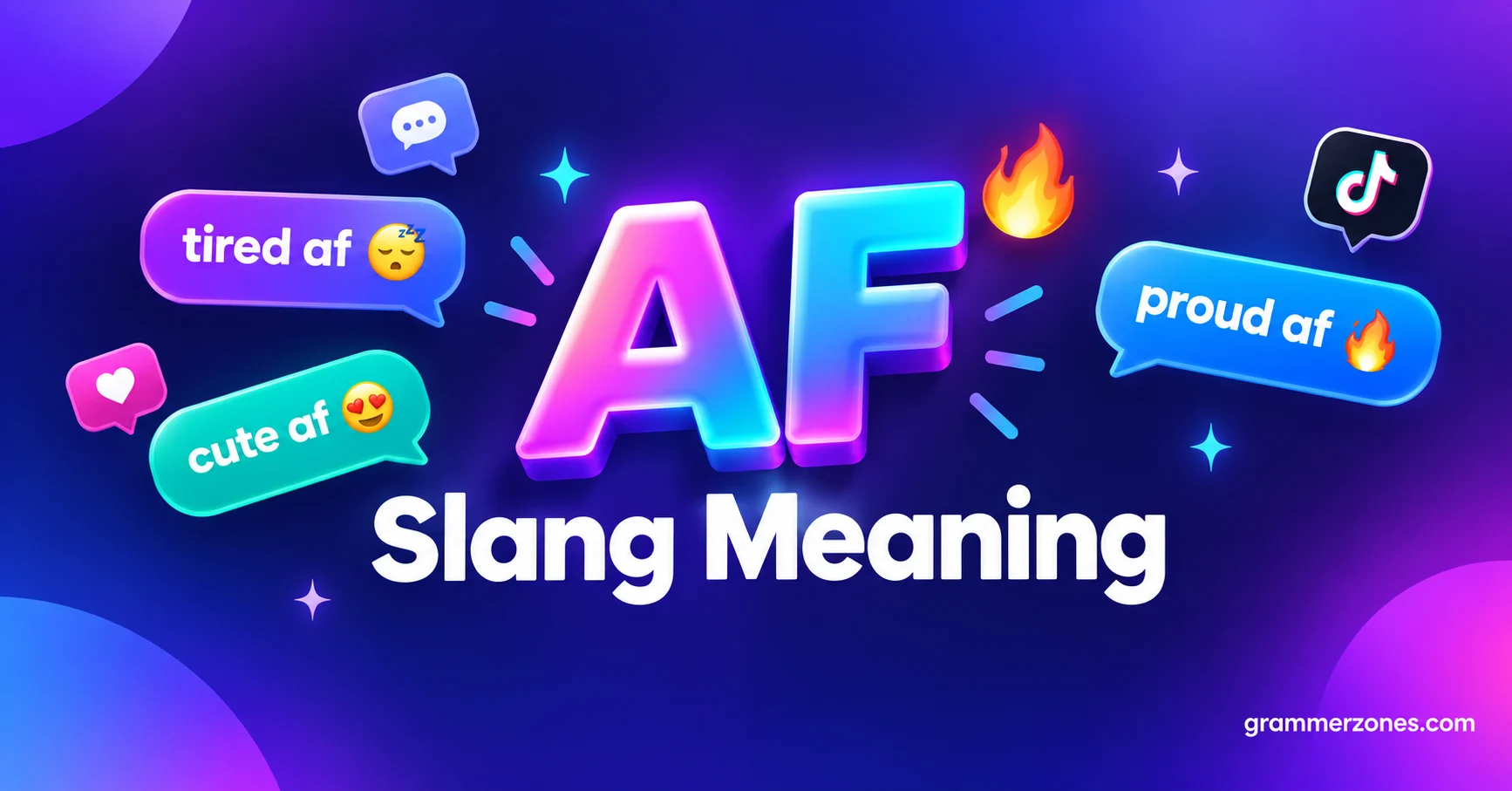
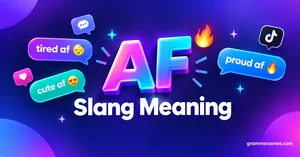
In slang, AF stands for as f***, and it works as an intensifier. It makes the word before it stronger: tired af means extremely tired, and cute af means really, really cute.
You’ve probably seen it under a selfie, in a group chat, or at the end of a TikTok caption and wondered if you were missing something. You weren’t. AF has become one of the most common intensifiers in digital communication, especially among Gen Z and millennials.
People search for the af slang meaning because the abbreviation looks simple but changes with context. It can be playful, blunt, sarcastic or flirty, and in a few other fields it means something else entirely.
This guide covers the full form, the background, how to use it, how to reply, and where it can trip you up.
Meaning and Definition
AF is an abbreviation, strictly speaking an initialism, because people say each letter: A-F. It stands for as f***, a phrase English speakers have long used to push an adjective to the extreme, much like as hell, as can be or to the max.
The pattern is adjective + AF: hungry af, broke af, proud af, funny af. It doesn’t change what the adjective means. It only turns up the volume. If someone says I’m tired, they’re tired. If they say I’m tired af, they’re exhausted.
Three things are worth knowing about how it behaves:
- It’s an intensifier, not a standalone word. Texting AF by itself usually reads as confusing unless the context makes the adjective obvious.
- It works with both positive and negative words. Happy af and annoyed af are equally normal.
- It carries a casual, slightly edgy tone. Because the full form is profanity, AF lives in informal conversation. Slang references such as Urban Dictionary list it as everyday internet slang, and it fits the register of text slang and netspeak.
A good rule of thumb: if you would say so, really or extremely to a friend, AF can replace it, but only in a relaxed setting. In a formal email, extreme is still the safer choice.
Background
Intensifiers built on strong language aren’t new. English has always had ways to exaggerate: dead tired, damn good, hella cool. The as f*** construction grew out of that habit, and it was shaped heavily by informal and street speech. Many linguists credit African American Vernacular English (AAVE) and hip-hop culture with helping popularize emphatic constructions like this one before they spread to mainstream youth speech.
What turned the phrase into the two-letter af was the speed of digital communication. Text messaging, early Twitter, and later Instagram, Snapchat and TikTok rewarded short, punchy writing. Typing as f*** takes more effort than af, and the abbreviation also softens the profanity slightly, since the word is never spelled out. That made it easy to drop into captions, comments and replies.
Social media then did the rest. Hashtags like #tiredaf and #blessedaf made the term searchable, memes spread it across platforms, and content creators used it in everyday language until it stopped feeling like an inside joke. Language researchers often point to this as a textbook case of how digital communication speeds up language evolution: a spoken habit becomes an abbreviation, the abbreviation becomes a trend, and the trend becomes standard informal vocabulary.
Today, AF is understood across age groups online, although younger users still use it more naturally and more often.
Usage in Different Contexts
Where you use AF matters as much as how you use it.
Casual conversation with friends. This is where AF is most at home. That movie was long and expected.
Social media captions. Creators use AF to add personality and rhythm: Monday mood: sleepy af ☕. It also helps with engagement, because it sounds like a real person talking.
Memes and comment sections. AF is a shortcut for strong reactions. This is genius af says more in three words than a paragraph would.
Workplace chats. This depends on the culture. In a relaxed startup Slack channel, a casual deadline is tight af might pass. In more formal settings, avoid it. Because it abbreviates profanity, it can still come across as unprofessional.
Professional or formal writing. Skip it entirely. Emails to clients, school assignments, job applications and official documents call for standard intensifiers like very or extremely.
Spoken language. People do say A-F out loud, usually for comedic emphasis: I’m hungry, like, A-F.
A simple test helps: if you wouldn’t swear in front of the person or audience, don’t use AF either. Reading your audience is the most reliable guide to using slang well.
Meaning in Chat, WhatsApp, Instagram and TikTok
The core meaning stays the same everywhere, but each platform gives AF a slightly different flavor.
Chat and WhatsApp. In private messaging, AF is relaxed and personal. Running late, stressed af signals real feeling without needing a long explanation. Friends often pair it with emojis: so excited af 😭🔥. In group chats it keeps the mood light.
Instagram. AF turns up in captions, Stories and comments. A caption such as grateful af adds warmth and humor. In the comments, you look amazing af is a strong compliment. Hashtags extend its reach, so a post tagged #happyaf can be discovered by strangers.
TikTok. The platform’s fast, trend-driven humor suits AF. Creators use it in on-screen text, captions and voiceovers: Me, tired af after one day of being an adult. It is also common in comment sections, where one-liners get the most likes.
Snapchat and X (Twitter). On both, brevity rules, so AF fits naturally into short messages and quick reactions.
Capitalization changes the tone slightly. af in lowercase feels casual and effortless. AF in capitals feels louder and more emphatic, like raising your voice. Neither is wrong, but the difference is worth noticing if you want your tone to land the way you meant it.
A final point on user intent: people who search for the meaning of AF in text or chat usually see it in a message and want a fast, clear answer. That’s why the safest reading, extremely, is almost always correct.
Meaning in Physics, Medical and Aircraft Terminology
AF is not only slang. Outside of social media, the same two letters appear in several technical fields, which is a big reason people get confused.
Medical: atrial fibrillation. In healthcare, AF (often written AFib) refers to atrial fibrillation, an irregular and often rapid heart rhythm. Doctors, nurses and cardiology resources use the abbreviation constantly. If you see AF on a medical chart or in a health article, it has nothing to do with slang. For anything about symptoms or diagnosis, rely on a qualified healthcare professional rather than a slang guide.
Physics and electronics: audio frequency. In electronics and physics, AF can stand for audio frequency, the range of sound frequencies humans can hear, roughly 20 Hz to 20 kHz. You’ll see it in radio engineering and audio equipment manuals.
Aviation: Air Force, airframe and Air France. In aircraft and military contexts, AF commonly means Air Force. In aircraft maintenance, the airframe (the structure of the aircraft without the engines) is sometimes shortened to AF. And in the airline industry, AF is the IATA code for Air France, so it appears on tickets and flight listings.
Photography: autofocus. Camera lenses and bodies are often labeled AF for autofocus.
How to tell the difference. Context is everything. A text from a friend that says tired af is slang. A medical report mentioning AF is cardiology. A flight booking showing AF is Air France. Check the surrounding words, the platform and the person’s profession, and the meaning usually becomes obvious.
Common Misconceptions
Because AF is short and multi-purpose, a few myths keep circulating.
Misconception 1: AF means Air Force in texts. Only in military or aviation discussions. In everyday chat, it’s the intensifier.
Misconception 2: AF is always rude. It’s informal and based on profanity, but most people use it with warmth, humor or affection. Proud of you is a sweet message. Tone and context decide how it lands.
Misconception 3: AF is the same as asf. They have the same meaning (as f***), but asf is a looser, less common spelling. AF has become the more standard form.
Misconception 4: AF is only for negative things. People use it for good and bad feelings alike: happy af, blessed af, angry af.
Misconception 5: It’s a brand-new trend that will vanish soon. Slang does come and go, but AF has stayed in use for years across several platforms, which suggests it’s firmly part of informal English.
Misconception 6: Anyone can use it anywhere. Not true. Using AF with your boss, a teacher or an older relative you barely know can create an awkward moment. Knowing the meaning is only half the skill; knowing the audience is the other half.
Misconception 7: It changes the meaning of the word before it. It doesn’t. It only amplifies. Cold af is still about cold, just more of it.
Getting these points right is the difference between sounding natural and sounding like you’re trying too hard.
Similar Terms and Alternatives
AF isn’t the only way to add emphasis. Here are the closest relatives, grouped by feel.
Slang equivalents
- asf: the same phrase, spelled slightly differently.
- hella: a West Coast favorite meaning very or really (hella good).
- mad: used in some regions (mad tired).
- lowkey / highkey: these shift the intensity down or up. Lowkey tired is subtle; highkey tired is obvious.
- deadass: means seriously or genuinely, and it often shows up next to AF for added emphasis.
Sincerity markers
- fr / fr fr: for real, used to confirm that you mean it.
- ngl: not gonna lie, which introduces an honest opinion.
- tbh: to be honest, a softer way to share a view.
- bet: a casual okay or sounds good.
Standard alternatives
- very, extremely, incredibly, super, really, totally.
When to choose which. If you want maximum informality, use AF or hella. If you want to sound sincere rather than exaggerated, add fr or ngl. If you are writing anywhere that matters professionally, swap in extremely or incredibly and move on.
Mixing is common too: Ngl, I’m tired af fr stacks three layers of casual emphasis. It’s natural in chat but unnecessary in most other situations.
How to Respond to It
When someone sends you a message with AF, the reply depends on what they said and how you want to come across.
Match their energy. If a friend writes I’m so excited af for tonight, a reply like Same!! It’s going to be so good mirrors the mood. You don’t need to use AF yourself.
Respond to the feeling, not the abbreviation. The slang is just emphasis. Focus on the emotion behind it:
- Stressed af about work → That sounds rough. Want to talk about it?
- Proud of this project → You should be! It looks incredible.
- Hungry af → Let’s order something right now.
Using AF back. If you’re comfortable with it, a playful reply works: Honestly, same af. This feels natural between friends and signals that you speak the same language.
When to keep it neutral. If you don’t know the person well, or the conversation is professional, respond in standard English. You can still be warm without the slang: That’s great news, congratulations.
Asking what it means. If you really aren’t sure, there’s no shame in it. A simple wait, what does af mean? is a perfectly normal question, and most people are happy to explain.
Examples of quick replies
- Sleepy af → Go rest, you earned it 😴
- Funny af → Right? I couldn’t stop laughing.
- Beautiful af → Thank you, that really made my day.
The best replies respond to the person, not just the word.
Differences from Similar Words
Slang terms overlap, but small differences change how a message feels.
AF vs. asf. Same meaning, different spelling. AF is more widely recognized and feels cleaner on screen.
AF vs. hella. Hella is a standalone word that comes before the adjective (hella cold), while AF comes after it (cold af). Hella has a regional, West Coast flavor. AF is more universal online.
AF vs. lowkey/highkey. AF boosts the strength of a feeling. Lowkey and highkey describe how openly you express it. Lowkey nervous means you’re hiding it a bit; nervous af means it’s intense.
AF vs. fr. Fr confirms honesty (that’s true, fr), while AF measures intensity. They answer different questions: how much? versus how real?
AF vs. very or extremely. The meaning is nearly identical, but the tone is not. Very is neutral and safe anywhere. AF is playful, informal and a touch edgy.
AF vs. emojis. Sometimes an emoji does the same job: so tired 😩 can match tired af. Many people combine them for double emphasis.
AF vs. other uses of the letters. In medicine, aviation or electronics, AF is a technical abbreviation with a fixed meaning. In slang, it’s flexible and attached to an adjective.
Seeing these distinctions helps you pick the right word for the right moment, and it helps you read other people’s messages more accurately.
Relevance in Online Conversations and Dating Apps
AF fits modern online communication because it’s fast, expressive and sounds like real speech. In a world of short messages, one small abbreviation can carry a lot of feeling.
On social platforms. AF helps people sound authentic. Brands and creators often use casual slang like this to feel relatable, though overusing it can look forced.
On dating apps (Tinder, Bumble, Hinge). Slang can set the tone of a conversation quickly.
- In a bio, funny af or adventurous af signals personality and humor.
- In early chats, a playful that’s cute af can come across as flirty. Done well, it shows confidence and a relaxed attitude.
- In ongoing conversations, AF helps keep things light: I’m nervous af about this date 😅 can actually make you seem honest and approachable.
A few cautions for dating.
- Don’t overdo it. A message packed with slang can feel careless or hard to read.
- Read the other person’s style. If they write in full, polished sentences, mirror that with a lighter touch.
- Remember the profanity underneath. Some people find it charming; others find it off-putting early on.
The bigger picture. Understanding terms like this is part of digital literacy. If you are writing a comment, replying in a group chat or crafting a dating profile, knowing the af slang meaning helps you read tone correctly and avoid misunderstandings. It also helps parents, teachers and employers follow what younger people are saying without needing a translator.
Conclusion
So what does AF mean in slang? It stands for as f***, and it simply means extremely. Add it after an adjective and you get instant emphasis: tired af, happy af, proud af. It started in casual speech, grew through texting and social media, and now appears on WhatsApp, Instagram, TikTok and dating apps alike.
Remember the key points. AF is informal, so save it for friends and relaxed spaces. It can mean something completely different in medicine (atrial fibrillation), electronics (audio frequency), aviation (Air Force, airframe, Air France) and photography (autofocus), so always check the context. And when you respond to it, answer the feeling rather than the abbreviation.
Slang keeps evolving, but the habit of exaggerating for effect never goes out of style. Now that you know how AF works, you can read it, use it and reply to it with confidence. If you spot a term you don’t recognize next, look at the context first, then check a trusted source.
Discover More!
TBH Slang Meaning: What It Really Means in Texts 💬
IDK Slang Meaning: What It Really Says When You Text It
SMH Slang Meaning: What It Really Says in Texts 🤦

I’m Mason Reed, a language and communication writer at GrammerZones.com. I specialize in explaining English meanings, grammar concepts, internet slang, texting abbreviations & social media terms in a clear and practical way. My goal is to provide accurate, easy-to-understand content that helps readers confidently navigate modern language and online communication.



1 thought on “AF Slang Meaning 😬 Don’t Text It Wrong!”