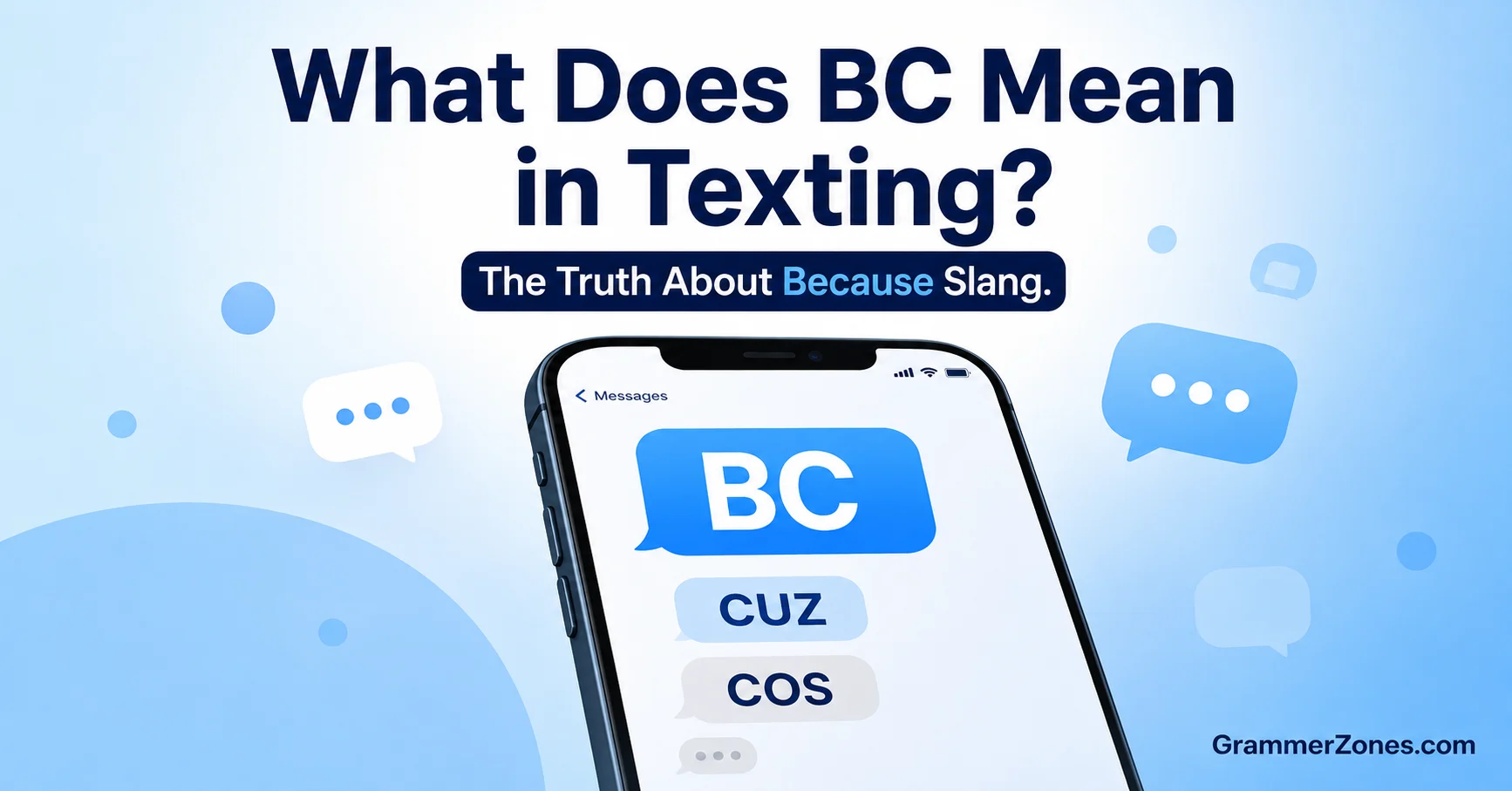
Quick answer: When texters shorten because to bc, cuz, cos, or coz, the meaning never changes it’s still just for the reason that. There’s no hidden code here.
What changes is tone: these clipped versions signal that a message is casual, fast, and off-the-cuff, which is exactly why they’ve taken over group chats, captions, and comment sections.
Why This Tiny Word Keeps Confusing People
It’s a strange thing to get stuck on. Because it is one of the most basic words in English, kids learn it before they can spell their own last name. And yet, type bc into a search bar and you’ll find thousands of people genuinely unsure what it means. Some assume it’s an inside joke. Others wonder if it’s short for before Christ, which, in a text thread about weekend plans, would be a strange thing to bring up.
The confusion isn’t really about the word. It’s about texting culture itself. We’ve all learned to expect that abbreviations hide something that smh means more than it looks like, that lol doesn’t always mean laughing. So when a plain, ordinary conjunction gets chopped down too, our brains go looking for a twist that isn’t there.
This guide breaks down exactly how because gets used in texting slang, where the different spellings come from, how the meaning shifts (or doesn’t) across WhatsApp, Instagram, and TikTok, and why a handful of oddly specific searches like the crossword clue version of this word keep landing people here.
The Actual Meaning, No Guesswork Needed
In texting shorthand, because is abbreviated, not replaced. You’ll most often see it as:
- bc by far the most common version, used everywhere from texts to Instagram captions
- cuz / cus a phonetic spelling that leans more casual, common in younger and more informal conversations
- cos / coz common in the UK, Australia, and parts of South and Southeast Asia
- b/c a slightly more restrained shorthand, sometimes used in emails or notes that sit between formal and casual
Every version does the same job: it connects a cause to an effect, faster than typing out all nine letters. That’s it. There’s no secondary or ironic meaning layered underneath, the way there sometimes is with slang like sus or based.
Where This Habit Actually Comes From
Shortening because it isn’t a Gen Z invention, even though it can feel that way. Linguists call this kind of word-shortening clipping the same process that turned advertisement into ad and influenza into flu. Clipped words have shown up in handwritten notes, telegrams, and shorthand systems for well over a century, long before smartphones existed.
What texting did was speed the process up and make it universal. Early SMS plans charged by the character or limited messages to 160 of them, so trimming a word like because down to two or three letters wasn’t just casual it was practical. That habit stuck around long after character limits stopped mattering, because by then it had become part of how digital conversation sounds: quick, unpolished, and a little breathless, the way speech actually is.
How the Tone Shifts by Platform
The meaning of because doesn’t change from app to app but the feel of using bc instead of the full word does.
In texting and WhatsApp, bc and cuz are just normal typing shortcuts, especially in group chats where messages fly back and forth quickly. Nobody reads anything into it.
On Instagram, bc shows up constantly in captions and can’t stop wearing this bc the fit is perfect where it works almost like punctuation, signaling that the caption is meant to sound thrown-together rather than polished.
On TikTok, comments and captions push even further into phonetic territory, with cuz and cos showing up more than the tidier bc, because the platform’s whole voice leans spoken rather than written.
In professional messages or emails, most people still spell it out. Abbreviating because in a work email can read as too casual, even if the same person uses bc fifty times a day in their personal texts. Context, not the word itself, decides what’s appropriate.
Common Misconceptions, Cleared Up
A few myths keep circulating around this word, so it’s worth addressing them directly:
BC always means ‘before Christ.’ Not in a text thread. Context resolves this almost instantly. Nobody reading can’t come because I’m working late and thinking about historical dating systems. If you do see because abbreviated in a more technical or formal document such as a medical note, a flight log, an engineering write-up it’s still just short for because. The word itself doesn’t carry a special technical definition in those fields; what changes across industries is how heavily people lean on abbreviations in general, not the meaning of this particular one.
Using ‘cuz’ or ‘bc’ is bad grammar. It isn’t incorrect, it’s an informal register. The same way gonna isn’t a grammar mistake in casual speech, bc isn’t a grammar mistake in a text. It just doesn’t belong in a cover letter.
These abbreviations are brand new. They’re not. What’s new is the scale everyone texting, all the time, on devices built for speed, has just made shorthand far more visible than it used to be.
Because as a Crossword Clue
If you landed here from a crossword, the answer is almost always short and literal: puzzles commonly used because → BC (or occasionally CUZ, COS, or AS, depending on the clue’s wording and letter count). Crossword constructors like it precisely because it has so many short, familiar abbreviations to choose from; it’s a flexible fill word. If your grid needs three letters, cuz or cos is worth trying; two letters almost always points to bc.
What People on Reddit Actually Say About It
Threads asking about texting abbreviations tend to follow a pattern: someone posts a screenshot, asks what a term means, and the top comment is usually a one-line, matter-of-fact answer it just means because, that’s it. That’s a fair summary of the whole topic. The conversations that get more engagement usually aren’t about what bc means, but about generational or regional differences for instance, some commenters note that cos feels distinctly British or Australian, while cuz reads as more American or younger-skewing. The word itself isn’t contested; the flavor of it is.
Similar Terms Worth Knowing
A few related shorthand terms tend to show up in the same conversations:
- b4 short for before, easy to confuse with bc at a glance but referring to timing, not causation
- idk bc I don’t know because, often used to explain uncertainty
- jk bc just kidding because, softening a joke with a quick explanation
- because reasons or because internet internet phrases where because is followed by a noun instead of a clause, used ironically to wave off a real explanation
How to Respond When Someone Uses It
There’s no special etiquette required. If a friend texts running late bc traffic, a simple no worries or got it keeps the same casual register. Matching the tone rather than replying with a full, formal sentence usually reads as more natural than correcting the abbreviation or asking what it means.
Why This Shows Up on Dating Apps Too
Dating app bios and opening messages lean on bc constantly swipe right bc why not, here bc my friend made me. It’s part of a broader pattern where casual, lightly self-deprecating language performs better than anything that sounds rehearsed. On these platforms, using shorthand isn’t laziness; it’s a small signal that someone isn’t trying too hard, which for better or worse tends to land well.
Quick FAQ
Does bc ever mean something other than because in texting?
Rarely, and context makes it obvious when it does (like before Christ in a history discussion). In everyday texting, it means because essentially every time.
Is cuz more casual than bc?
Generally, yes. Cuz tends to show up in more informal, younger-skewing conversations, while bc is used across almost every age group and platform.
What’s the crossword answer for because?
Most commonly BC; occasionally CUZ, COS, or AS, depending on the clue and grid length.
Is it okay to use bc in a work email?
It’s best avoided in formal writing. Spelling out because is still the safer choice for professional or academic contexts.
The Bottom Line
Because it is proof that not every piece of texting shorthand needs decoding, sometimes a word just gets shorter because typing is faster that way. if it shows up as bc in a group chat, cuz in a TikTok comment, or as a three-letter crossword answer, the meaning holds steady even as the spelling shifts.
What actually changes is what that shorthand signals: speed, informality, and a kind of conversational shorthand that’s become second nature across nearly every platform people use to talk to each other. Next time it shows up in your messages, you won’t just know what it means you’ll know exactly why it’s there.

I’m Mason Reed, a language and communication writer at GrammerZones.com. I specialize in explaining English meanings, grammar concepts, internet slang, texting abbreviations & social media terms in a clear and practical way. My goal is to provide accurate, easy-to-understand content that helps readers confidently navigate modern language and online communication.






2 thoughts on “What Does BC Mean in Texting? Truth About “Because” Slang”