Short answer: nine times out of ten, when a tree or trees shows up in a text, comment, or caption, someone’s talking about marijuana. But that’s not the whole story. The same word carries completely different weight in a medical chart, a cockpit, or a genealogy chart, and knowing which one you’re looking at comes down to context, not the word itself.
Here’s the thing about slang: it never behaves the way a dictionary wants it to. You’ll see trees dropped into a WhatsApp message between friends, then see the exact same word show up in a bronchial anatomy diagram an hour later, meaning something entirely clinical.
That gap is exactly why so many people end up Googling tree slang meaning in the first place, usually right after reading a message that didn’t quite add up, or scrolling past a comment that made everyone else laugh except them.
This guide walks through where the slang actually came from, how it shifts across chat apps and professional fields, where people commonly get it wrong, and how to read the room before you reply. No fluff, no recycled definitions, just a clear map of a word that means very different things depending on who’s saying it.
What Tree Actually Means
In casual, informal speech especially online trees (almost always plural) is shorthand for cannabis. Someone texting got trees, pull ups isn’t talking about landscaping. It sits in the same slang family as bud, loud, or flower, and you’ll hear it most from younger, internet-fluent speakers rather than in formal writing.
But strip away the slang context, and tree reverts to its ordinary meanings fast:
- Family tree a chart mapping out someone’s ancestry
- Money tree shorthand for an easy, seemingly endless source of cash (money doesn’t grow on trees)
- Decision tree a branching diagram used in business, statistics, and computer science to map choices and outcomes
- A tall or lanky person occasionally used half-jokingly, as in built like a tree
None of these carry any cannabis connotation whatsoever, and that’s really the whole puzzle in one sentence: the same four letters, doing completely different jobs, and the only way to tell them apart is the context of who’s talking, where, and about what.
Where the Slang Came From
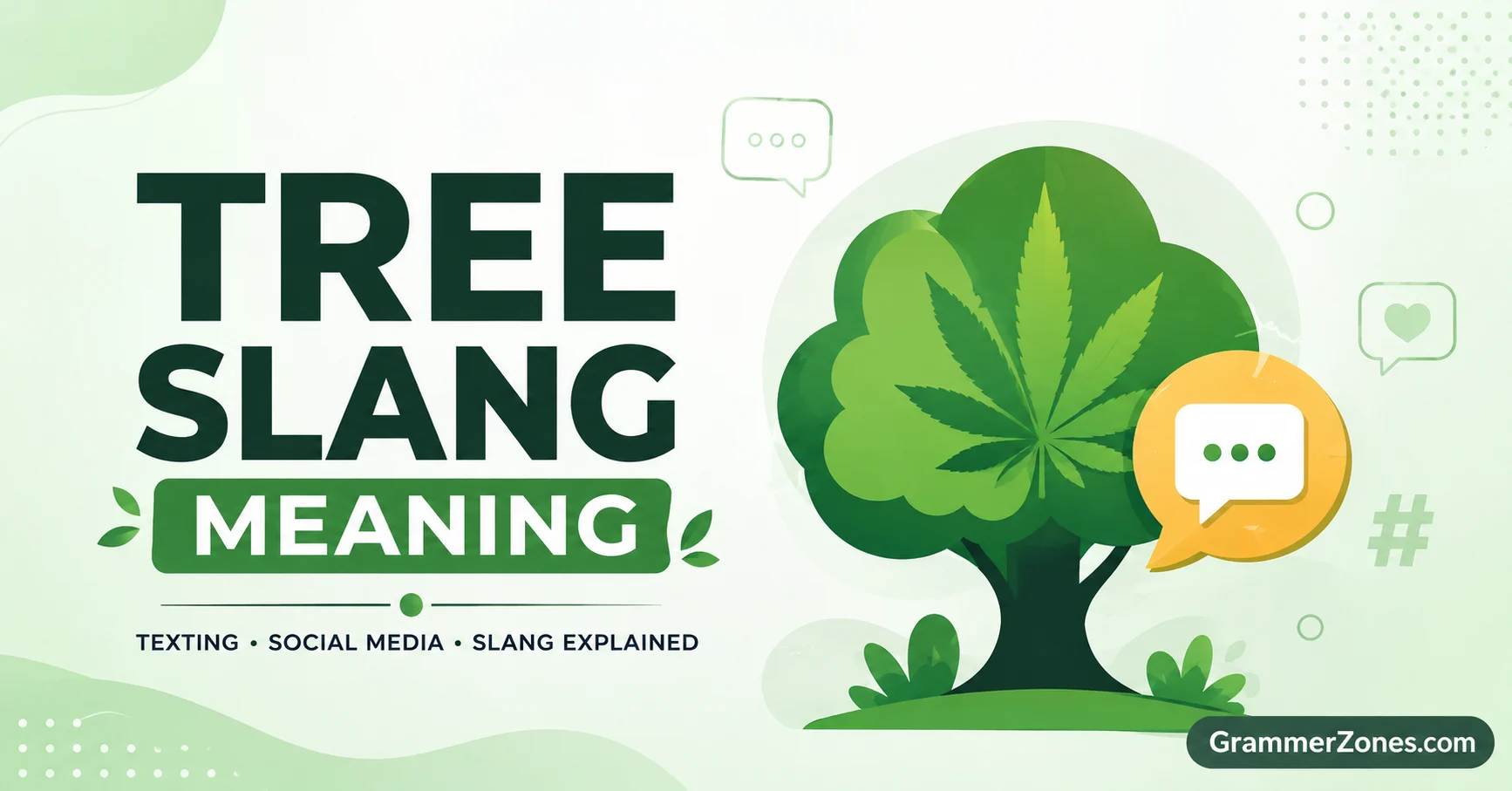
Cannabis slang doesn’t get coined in a boardroom; it spreads organically, usually starting in music, street culture, or small online communities before drifting into wider use. Trees likely caught on for a fairly literal reason: the plant itself looks like a miniature version of one, with a central stem, branching structure, and leafy canopy. That visual logic is common in drug slang; generally plenty of terms borrow from what something physically resembles rather than inventing a word from scratch.
Hip-hop culture in the late ’90s and 2000s helped push the term into mainstream youth vocabulary, and message boards and early social media did the rest, repetition is really all slang needs to stick. By the time Urban Dictionary became the unofficial reference point for this kind of language, trees was already a settled entry rather than a fringe term.
What’s interesting from a language standpoint is that this is a textbook case of a word living two lives at once technically unchanged, but carrying an entirely different meaning depending on the room you’re in. That’s not unique to trees, but it’s a clean example of how modern slang actually functions.
How Context Changes Everything
The same word, four completely different settings:
Texting between friends. This is where the slang meaning dominates almost entirely. Trees in a private chat, especially paired with a plant or leaf emoji, is cannabis shorthand nearly every time.
Professional or academic writing. The slang basically doesn’t exist here. A report, essay, or workplace email using tree means exactly what the dictionary says it means literal, structural, or idiomatic, never cannabis.
Gaming culture. Tech tree and skill tree are common terms in strategy and RPG games, referring to upgrade paths. It’s a completely separate lineage from the drug slang, but it does occasionally confuse newer players Googling the term for the first time.
Music, memes, and captions. Lyrics, jokes, and meme formats tend to lean on the cannabis meaning specifically because it’s recognizable using a word everyone already half-knows is part of what makes a joke land.
The pattern holds across almost every slang term: meaning isn’t fixed in the word, it’s fixed in the setting. That’s also exactly why search engines have gotten better at reading intent rather than just matching keywords: a query about tree slang surrounded by chat and Urban Dictionary results looks very different, algorithmically, from one surrounded by botany or forestry sites.
Chat Apps and Social Media: Where It Shows Up Most
Different platforms lean into the slang differently:
- WhatsApp tends to be the most direct private, friend-to-friend conversations where trees plus a leaf emoji is about as unambiguous as slang gets.
- Instagram splits down the middle. Captions on nature or travel posts mean it literally; captions on lifestyle or humor posts usually don’t.
- TikTok moves fast enough that tree sometimes gets pulled into a completely unrelated meme trend for a week or two before reverting back, worth checking the sound or format it’s attached to before assuming.
- Reddit and X (Twitter) are often where new spins on the word get argued over or joked about first, before they trickle down into everyday use elsewhere.
If a message using a tree doesn’t make literal sense in context, the slang reading is almost always the right guess, especially in casual, low-stakes conversation.
When Tree Means Something Entirely Clinical or Technical
This is the part that trips people up most, because the same word shows up in fields where slang has zero business being.
Medicine uses trees purely descriptively. The bronchial tree refers to the branching airway structure inside the lungs; the biliary tree refers to the bile duct network in the liver. Both terms exist because the anatomy genuinely branches out like a tree; there’s no euphemism buried in there at all.
Computer science and physics use trees as a structural term: a decision tree, a binary tree, a phylogenetic tree in evolutionary biology. These describe hierarchical, branching data or relationships, and the term is centuries older in mathematics than the slang version.
Aviation occasionally uses the Christmas tree informally to describe a fully illuminated instrument panel or a lit runway approach system again, a purely visual comparison, nothing coded about it.
Mixing these up isn’t just a funny mistake, it’s a genuine misread that can matter, especially if you’re reading medical notes or technical documentation and a slang assumption creeps in where it doesn’t belong. When accuracy actually counts, context always overrides casual reading.
Common Mix-Ups Worth Clearing Up
A few things people regularly get wrong:
- Tree always means weed. Not even close it depends entirely on setting, and assuming otherwise in a professional or medical context can cause genuine confusion.
- Spelling variants like trees carry the same weight as trees. They don’t. Treesh is a stylized, informal offshoot used in small online slang pockets not something you’ll find standardized anywhere, and definitely not something to assume a general audience will recognize.
- All the tree-specific idioms mean the same thing. A palm tree reference, a redwood joke, and Lemon Tree (an actual, well-known cannabis strain name) aren’t interchangeable; each has its own specific cultural shorthand rather than being generic stand-ins for weed.
Similar Terms, and How They Differ
A few words get lumped in with trees that actually mean something distinct:
- Wood sometimes shows up in cannabis-adjacent slang too, but it carries its own separate, often unrelated meanings depending on the community using it; it’s not a direct synonym, just a neighboring term.
- Tress is a different word entirely; it means a lock of hair. It’s phonetically close to trees and gets typed by accident more often than you’d think, but the two have no shared meaning at all.
- Treesh, as mentioned above, is really just trees with a stylistic twist, popular in specific slang circles rather than in general use.
Knowing these boundaries matters if you’re trying to actually understand a conversation rather than just guess at it.
How to Respond Without Guessing Wrong
Before replying to a message using tree in a way that seems off, run through this quickly:
- Is this a casual chat with friends?
- Slang meaning is very likely.
- Is this professional, academic, or medical?
- Almost certainly literal or technical.
- Is there a meme, emoji, or joke format attached?
- Probably playful slang.
If you’re genuinely unsure, a light, non-committal reply keeps things natural without putting your foot in it either way.
Dating Apps and Online Conversations
On apps like Tinder, Hinge, or Bumble, a casual 420 friendly or tree-emoji reference in a bio is a common, low-pressure way people signal lifestyle compatibility before a real conversation starts; it’s coded, but not exactly subtle once you know what to look for. The same logic shows up across group chats, comment sections, and forums generally: casual slang works as a quick filter, letting people signal something to the right audience while staying vague enough not to matter to anyone else reading it.
Quick Answers to Common Questions
Does tree always mean marijuana in slang?
No. It’s the most common informal meaning, especially in casual chat, but professional, medical, and technical contexts use tree completely literally.
What does trees mean?
It’s an informal spelling variation of trees, used mostly within specific online slang communities rather than as a widely recognized term.
Is tree the same as wood in slang?
Not directly. Both show up in casual, cannabis-adjacent conversation, but they come from different slang lineages and aren’t interchangeable.
Why do medical and aviation fields use the word tree too?
Because of the branching, tree-like shape of certain structures like airways in the lungs or lit-up instrument panels not because of any connection to slang.
Conclusion
There isn’t one single answer to what tree means and that’s really the point. In casual text, it’s almost certainly cannabis slang. In a medical chart, it’s the branching structure of an airway. In a family history document, it’s your ancestry laid out branch by branch.
The word hasn’t changed; the room it’s standing in has. Once you get used to reading context instead of just the word itself, moments like a confusing DM or an oddly specific caption stop being confusing at all; you’ll just know which tree you’re looking at.

I’m Olivia Cruz, a content writer at grammerzones.com, specializing in clear, user-friendly blog posts on grammar and modern slang meanings. I focus on simplifying complex terms including drug and gang slang into accurate, easy-to-understand content.