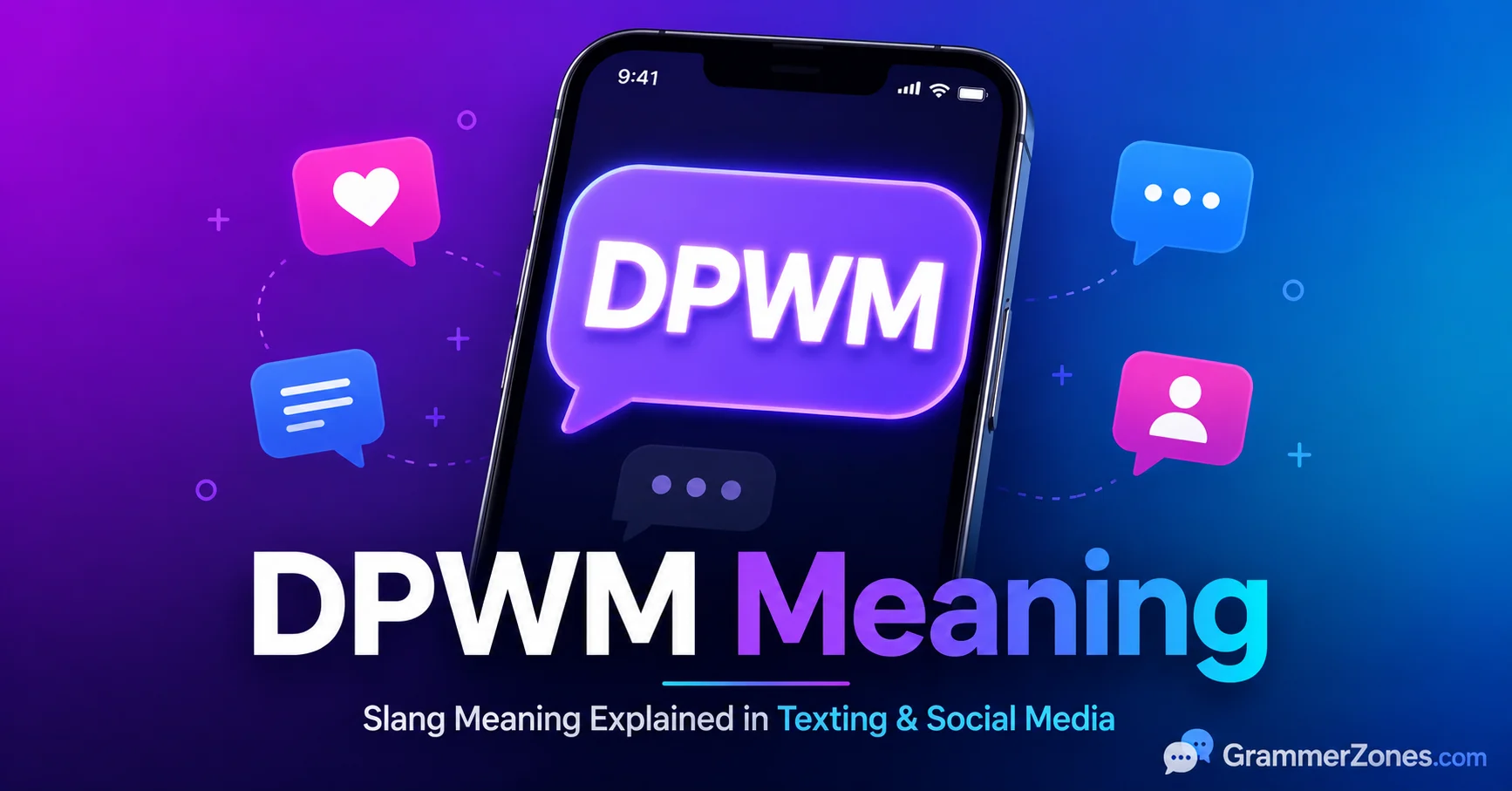
DPWM means Don’t Play With Me. It’s a texting shorthand people drop into a chat to say, in effect, I’m not joking or don’t test me and if it lands as a warning, a joke, or a flirty jab depends almost entirely on who sent it and what came right before it.
Someone sends DPWM and suddenly you’re staring at your phone doing acronym math. It’s not a new problem texting culture produces these compact, tone-heavy phrases constantly, and DPWM is one of the more ambiguous ones because it can mean three different things depending on context: a genuine boundary, a joke between friends, or a flirty deflection on a dating app.
That ambiguity is the whole reason people search for it instead of just guessing. Below, I’ll walk through where the phrase actually comes from, how its meaning shifts across texting, Instagram, TikTok, and Snapchat, the unrelated engineering term that shares the same four letters, and most usefully how to actually reply when it shows up in your own messages.
What DPWM Means
DPWM expands to Don’t Play With Me. That’s the whole acronym, no hidden variations, no regional alternate spellings. What changes is the emotional weight behind it.
In practice, it tends to show up in one of three moods:
- Genuinely firm. Someone is tired of being teased or doubted and wants that acknowledged.
- Mock-serious. A friend says something wild, you don’t believe them, and DPWM is their way of doubling down half joke, half insistence.
- Confident or flirty. Especially in dating-app exchanges, it can function less as a warning and more as a personality flex, a way of signaling I know what I want without saying anything that direct.
Because none of that comes through in four letters alone, the real decoding work happens in tone: punctuation, emoji, capitalization, and the relationship between the two people talking. A DPWM 😭😂 and a plain DPWM. are, functionally, two different sentences.
Where It Comes From
Acronyms like this one aren’t random; they’re a byproduct of how fast modern messaging moves. TikTok comment sections, Snapchat replies, and Instagram DMs all reward brevity: short character counts, quick back-and-forth, and reactions typed in seconds rather than composed. Phrases that carry attitude in four letters spread faster than full sentences ever could.
DPWM sits in the same family as other assertive, boundary-flavored shorthand that’s become common among younger texters; the kind of phrase that exists specifically because I’m serious right now takes too long to type when you’re mid-conversation. It’s not tied to one platform’s algorithm or one specific meme moment; it’s more of a slow accumulation of usage across group chats and comment sections until it became recognizable shorthand on its own.
How It’s Used Chat vs. Social Media vs. Work
Context changes everything with this phrase:
- Texting and group chats are the most natural home for it. Usually a quick reaction to teasing or disbelief.
- Public comments (TikTok, Instagram) are often performative in a fun way, meant for an audience rather than just the other person.
- Gaming chat used to signal you’re locked in and not messing around, especially mid-match.
- Professional or work messaging is where it doesn’t belong. Dropping slang like this into an email or a Slack thread with a client reads as careless, not confident. If you wouldn’t say don’t play with me out loud in a meeting, don’t type the acronym version either.
Platform-by-Platform: Text, Instagram, TikTok, and Snapchat
The phrase doesn’t behave identically everywhere it shows up.
In regular texting or WhatsApp, it’s usually the most literal version of itself, a direct reaction to something surprising, sarcastic, or slightly unbelievable.
On Instagram, it shows up a lot in comment threads and DMs, often with a flirtier or more performative edge than a private text would carry. Someone commenting under a post is usually playing to an audience, not issuing an actual warning.
On TikTok, it’s arguably at its most common, usually as a reply to a bold claim in a video or a caption that dares someone to react. The comment-section version of the phrase leans dramatic on purpose; that’s part of the appeal.
On Snapchat, it’s less standardized than the other three. Because Snapchat conversations tend to be more private and ongoing, the phrase can drift toward being a private shorthand between two specific people rather than something with one fixed meaning which is part of why it’s harder to pin down there than it is on a public comment thread.
The Unrelated Technical Meaning
Outside of slang, DPWM also stands for Digital Pulse Width Modulation, a real term in electronics and signal processing, used to describe a digital method of controlling how much power gets delivered to a circuit. You’ll see it in contexts like motor control or LED dimming, and it has absolutely nothing to do with the texting version. There isn’t a standardized medical or aviation meaning for the acronym; where it does appear in those fields, it’s typically a one-off abbreviation specific to a single document rather than an industry-wide term.
If you land on an engineering forum instead of a TikTok comment section while researching this, that’s why the same four letters, completely different world.
Where People Get It Wrong
A few misconceptions come up often enough to be worth clearing up directly:
- It’s not automatically hostile. A lot of people assume the phrase always signals anger. In practice, it’s more often teasing than confrontational.
- It’s not gendered. The phrase itself doesn’t shift meaning based on who’s typing it: a message from a friend, a match, or a sibling all use the same four letters. What changes is context, not the words themselves.
- It’s not a fixed, dictionary-locked term. Crowdsourced slang sites tend to have inconsistent, user-submitted entries for phrases like this, so don’t expect one canonical definition anywhere; the real definition lives in how it’s actually used, not in a single reference entry.
- It’s not brand new, even though it can feel that way the first time you see it. Phrases like this tend to simmer in group chats for a while before becoming visible enough that people start searching for them.
Similar Phrases
DPWM belongs to a small cluster of boundary-setting texting shorthand. British slang has its own version of the same energy in phrases like don’t mug me off. Within English-language texting culture more broadly, it sits alongside other short, punchy warnings that exist to convey I mean this without spelling out a full sentence the exact acronym varies, but the impulse behind it doesn’t.
How to Actually Respond
The safest move is to mirror the tone you’re being given, not escalate past it.
- If it comes with emojis or follows a joke, treating it as a joke back a laugh or a light comeback is fine.
- If it reads flat or serious with no punctuation softening it, it’s reasonable to just ask directly: Wait, are you being serious right now?
- Don’t assume the worst by default. Most of the time, this phrase is doing far less emotional work than it looks like at first glance.
How It’s Different From Similar Slang
Compared to lighter tags like lol or jk, DPWM carries more weight than it’s meant to be noticed. But compared to an actual confrontational opener, it’s usually much softer than it sounds. It occupies a specific middle ground: assertive enough to get attention, casual enough to still be a joke half the time.
Why It Shows Up So Often on Dating Apps
In dating-app conversations specifically, this phrase tends to function less like a warning and more like a small personality signal, a way of projecting confidence or setting an early boundary without sounding overly serious. It’s common enough in that context that seeing it early in a match doesn’t necessarily mean anything went wrong; it’s often just someone’s way of being playfully direct.
Final Thoughts
Strip away the platform-specific quirks and the meaning stays constant: DPWM is Don’t Play With Me, a compact way of saying take this seriously that can flex between firm, funny, and flirty depending entirely on the person sending it and the conversation around it.
The real skill isn’t memorizing the acronym it’s reading the tone it’s wrapped in, which is true of most texting shorthand. And if you ever run into the same four letters in a completely different setting, like an electronics spec sheet, that’s Digital Pulse Width Modulation doing its own unrelated thing. Different world, same letters, no relation.
Discover More About
Based Meaning: Definition, Origin & Online Use
Gas Slang Meaning: What That’s Gas Really Means 🔥
WYF Meaning in Text: What It Really Means on Instagram & Chat

I’m Andrew West, a content writer at GrammerZones.com, specializing in high-ranking grammar blogs and modern language trends. I simplify complex grammar and decode Gen Z and Gen Alpha slang to make communication clear, relevant, and engaging.





1 thought on “DPWM? Don’t Play With Me Meaning in Texting & TikTok”