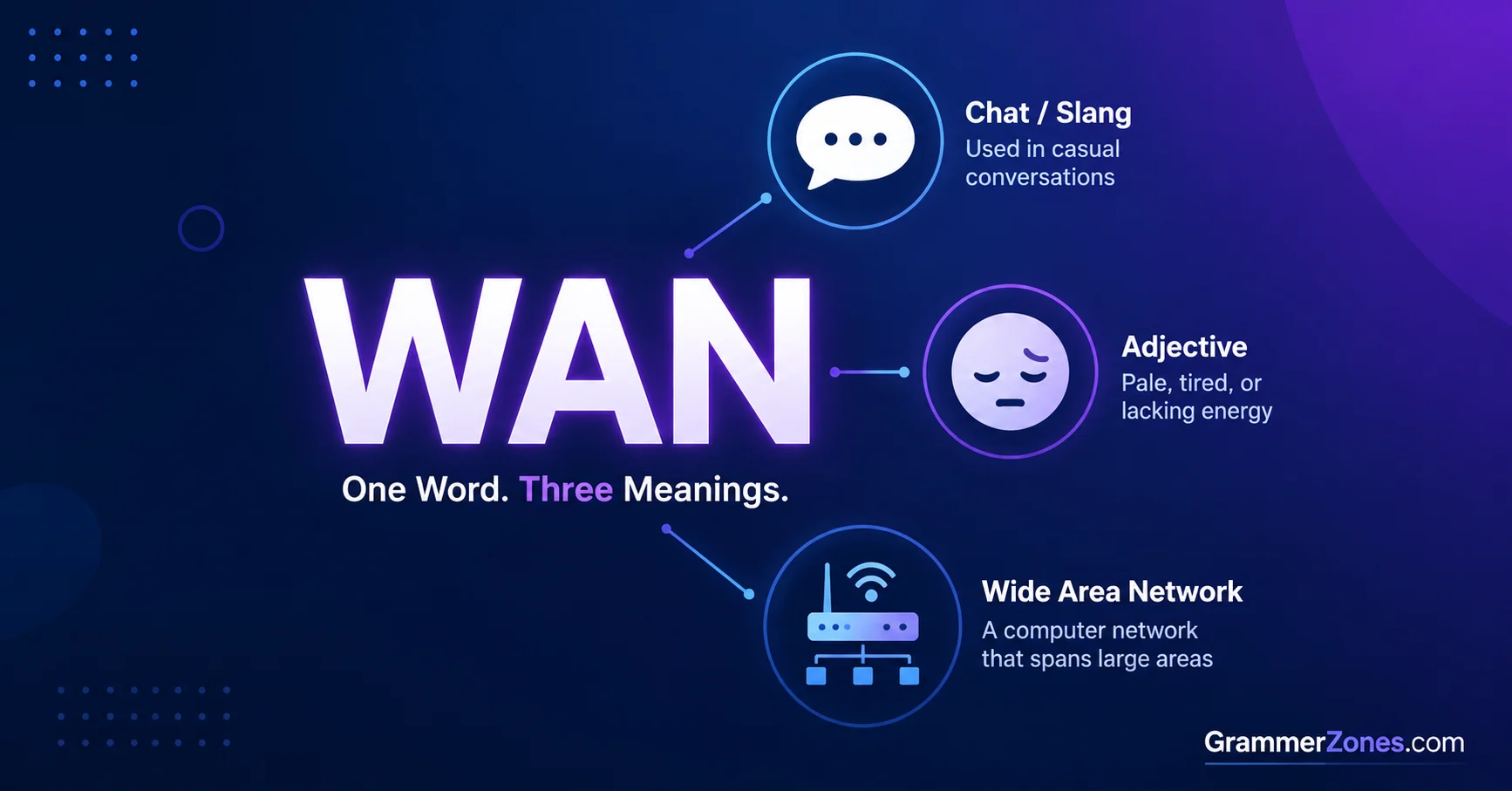
If you searched for wan, here’s the short version: in a text or DM, wan almost always just means want (I wan see you later). In a dictionary, it’s a real English word for looking pale, tired, or drained (a wan smile). And on your router settings page, WAN stands for Wide Area Network, the connection linking your home to the wider internet. Same four letters, three completely different jobs.
It’s a strange little word to search for, honestly I’ve watched people land on this exact confusion three different ways: someone gets a text that just says wan, a router manual throws WAN port at them with zero explanation, or they stumble on the word in an old novel describing a character’s wan complexion and assume it’s a typo.
It isn’t. All three meanings are legitimate, and knowing which one applies to your situation is really just a matter of context, which is exactly what this guide sorts out, one use case at a time.
What Wan Actually Means
There are three separate meanings hiding under this one spelling, and mixing them up is the single most common source of confusion.
As slang, wan is a clipped, phonetic version of want. It’s most associated with Nigerian Pidgin English and West African English more broadly I want to translate to I want to eat and it’s since traveled into general internet texting shorthand through music, TikTok, and casual chat, where dropping a letter or two just saves time.
As standard English, wan is an adjective that’s been in the language for centuries, meaning pale, sickly, or lacking energy. Merriam-Webster and most major dictionaries define it this way: a wan face or smile suggests weariness, illness, or emotional exhaustion rather than genuine warmth. You’ll see it constantly in classic literature: a character growing pale and wan after bad news or a long illness.
As an acronym, WAN means Wide Area Network, a computer network that spans a large geographic area, connecting multiple smaller networks together. This is the meaning IT professionals, router manufacturers, and telecom providers use, and it has zero linguistic connection to the other two.
Pronunciation differs slightly too: the slang and adjective forms rhyme with swan (rhymes with on, roughly wahn), while the acronym WAN is typically either spelled out letter by letter or pronounced as one syllable, depending on the technical context.
Where the Slang Comes From
The want shorthand didn’t appear out of nowhere. It’s rooted in Nigerian Pidgin English and related West African English dialects, where dropping the t is a natural feature of the spoken rhythm, not just a texting shortcut. Over the past decade, Afrobeats’ global rise, Nigerian Twitter culture, and diaspora social media communities have carried the phrase far beyond its origin, and now you’ll see wan used casually by people who have no direct connection to Pidgin at all it’s simply absorbed into broader internet English the way lowkey or extra did.
The older, literary sense of wan (pale, feeble) has a completely separate history in the English language, tracing back to Old English wann, meaning dark or gloomy, which shifted over time to mean pale or colorless. It’s the kind of word that shows up more in poetry and prose than casual conversation today, which is part of why it can feel unfamiliar even to fluent English speakers.
WAN, the networking term, is newer, still a product of 1970s and ’80s computer science, when engineers needed a clear way to distinguish a network confined to one building (a LAN) from one stretching across cities or countries (a WAN). None of these three histories overlap. They just happen to share a spelling.
Wan in Texting, WhatsApp, Instagram and TikTok
This is the context most people searching for slang meaning actually have in mind. On WhatsApp and Instagram DMs, wan shows up almost exclusively as shorthand for want casual, low-effort, often paired with other clipped words:
- wan link up later?
- I just wan know if you good
- u wan come thru?
On TikTok, it appears frequently in comment sections and captions, often blending Pidgin-influenced phrasing with Gen Z internet slang. It’s not tied to one platform or one demographic anymore; it’s become part of a broader, informal digital English that spreads fastest wherever short-form video and quick comments dominate.
Worth noting: none of this is incorrect English needing correction. It’s a dialect feature and a texting convention, the same way gonna or kinda are functional, understood, and not something you need to fix when you see it.
The Adjective Sense: Pale, Weak, and Wan Smile Explained
Outside of chat, wan shows up as a genuine descriptive word most often paired with appearance or emotional state. A wan smile is a faint, tired one the kind someone gives when they’re trying to be polite but clearly don’t have much energy behind it. Pale and wan is a common pairing in fiction, usually describing someone recovering from illness, grief, or exhaustion.
You’ll occasionally find this usage in health writing or medical narrative contexts too: a nurse’s notes or a memoir might describe a patient’s complexion as though it’s a descriptive, literary word rather than formal clinical terminology. If you’re looking for the medical term for paleness, that would be pallor; wan is the more evocative, everyday cousin of that word.
WAN in Networking: What It Means for Your Router and Internet Connection
This is where the word becomes genuinely technical, and it’s worth being precise here since a lot of people land on this term while troubleshooting their own home network.
WAN (Wide Area Network) is a network that connects computers and smaller networks across a large distance to a city, a country, or the entire globe. The internet itself is technically the largest WAN in existence.
LAN (Local Area Network), by contrast, is confined to a single location: your home Wi-Fi, or the network inside one office building.
On most home routers, you’ll see a WAN port and several LAN ports. The WAN port is the one that connects to your modem or ISP box; it’s your link to the outside internet. The LAN ports (or your Wi-Fi network) connect your own devices to each other and, through the WAN port, out to the wider internet.
| Term | Scope | Typical Use |
| LAN | Single building or home | Connects your own devices (laptop, phone, printer) |
| WAN | City, country, or global | Connects separate LANs together including the internet itself |
| WWAN | Wireless, wide-area | Uses cellular/satellite signal instead of cables (mobile hotspots) |
| SD-WAN | Software-managed WAN | Cloud-based control over WAN traffic, common in business IT |
SD-WAN (Software-Defined WAN) is a more modern approach that businesses use to manage their wide area network through centralized, cloud-based software rather than manually configuring physical hardware at every location; it’s become a standard tool for companies with multiple offices or remote teams needing efficient, secure connections between them.
If your router setup or ISP documentation uses the word WAN, it has absolutely nothing to do with the slang or adjective meanings above. It’s a separate technical vocabulary, and treating it as such avoids a lot of unnecessary confusion.
Common Misconceptions Worth Clearing Up
The biggest mistake people make is assuming there’s one correct meaning and everything else is a mistake. There isn’t. Slang, standard English, and technical acronyms coexist under the same spelling without conflict. Context tells you which one you’re dealing with, not the word itself.
A second mix-up: confusing WAN with the Star Wars character Obi-Wan. The names share a sound, nothing more; there’s no etymological link between the Jedi title and either the networking term or the slang word.
And a smaller but common error: assuming wan (adjective) is old-fashioned or obsolete. It isn’t dead, it still appears regularly in fiction, journalism, and even casual conversation among people who read a lot, particularly to describe a tired or unconvincing smile.
Similar Words and Alternatives
If you’re looking for alternatives depending on which meaning you need:
- In place of the adjective (pale, tired-looking): pallid, ashen, sickly, faint, drawn, colorless
- In place of the slang (want): wanna, tryna, dey wan (Pidgin variant), finna (regional US slang)
- In networking, related terms you’ll often see alongside WAN: LAN, MAN (Metropolitan Area Network), VPN, WWAN, SD-WAN, intranet
How to Respond When You See Wan in a Message
If someone texts you want, just read it as you want and respond naturally. There’s no need to point out the spelling or treat it as an error. Want to grab food later? gets the same reply as wanting to grab food later? would. It’s a stylistic choice, not a mistake to correct.
If you’re reading WAN in a technical document, router manual, or IT conversation, there’s nothing to respond to in a conversational sense, just recognize it as shorthand for Wide Area Network and read the surrounding sentence with that in mind.
Wan vs. Similar-Looking Words
- Wan vs. Want Wan is simply a shortened, informal spelling of want. They’re not different words; one is a casual version of the other.
- Wan vs. One In a handful of dialects, wan can phonetically double for one, though this is far less common than the want usage and usually clear from context.
- Wan vs. WAN (the acronym) Identical spelling, unrelated meaning. One belongs to casual conversation, the other to computer networking.
- Wan vs. Pale Close cousins, but not identical. Pale describes skin tone alone; wan usually implies tiredness or weakness behind that paleness; it’s a word with a bit more emotional weight.
Why Wan Shows Up So Often in Texting and Dating Apps
On dating apps and casual messaging, wan tends to appear in low-pressure, breezy openers wan get coffee sometime? because it fits the quick, unpolished tone that most digital flirting runs on. Nobody wants to read a formally punctuated paragraph in a first message; a clipped, casual wan signals ease and low stakes, which is exactly the tone most people are going for in that setting. It’s less about the word itself and more about what casual spelling choices communicate: relaxed, unbothered, not trying too hard.
Quick Answers (FAQ)
What does wan mean in slang?
It’s shorthand for want, commonly used in texting and Nigerian Pidgin English.
What does WAN mean in networking?
Wide Area Network a network connecting devices or smaller networks across a large geographic area, including the internet itself.
Is wan a real English word?
Yes. Beyond slang, wan is a standard dictionary adjective meaning pale, tired, or lacking vitality.
What’s the difference between LAN and WAN?
A LAN covers one location, like a home or office. A WAN connects multiple LANs across greater distances.
What does SD-WAN mean? Software-Defined WAN is a way of managing a wide area network through centralized software instead of manual hardware configuration, widely used in business IT.
Final Thoughts
Wan is a good reminder that English doesn’t always play fair. The same four letters can mean I want, I look exhausted, or this connects to the internet, depending entirely on where you encounter them.
In a text, take it as casual shorthand for want, no correction needed. In a novel or conversation about someone’s appearance, it’s describing paleness or fatigue. And on a router or in an IT conversation, WAN is doing a completely different job as Wide Area Network.
None of these meanings are wrong, rare, or outdated; they’re just different enough that context, not the word itself, is what tells you which one you’re looking at. Next time it shows up, you’ll know exactly where to place it.
Discover More About
WSP Mean? The Slang Everyone Uses Online
YH Mean? Texting, Snapchat & TikTok Slang Explained
TM Slang Meaning: Quick, Clear & Easy Guide

I’m Andrew West, a content writer at GrammerZones.com, specializing in high-ranking grammar blogs and modern language trends. I simplify complex grammar and decode Gen Z and Gen Alpha slang to make communication clear, relevant, and engaging.





1 thought on “Wan Slang Meaning Explained: From Texting to WAN Networking”