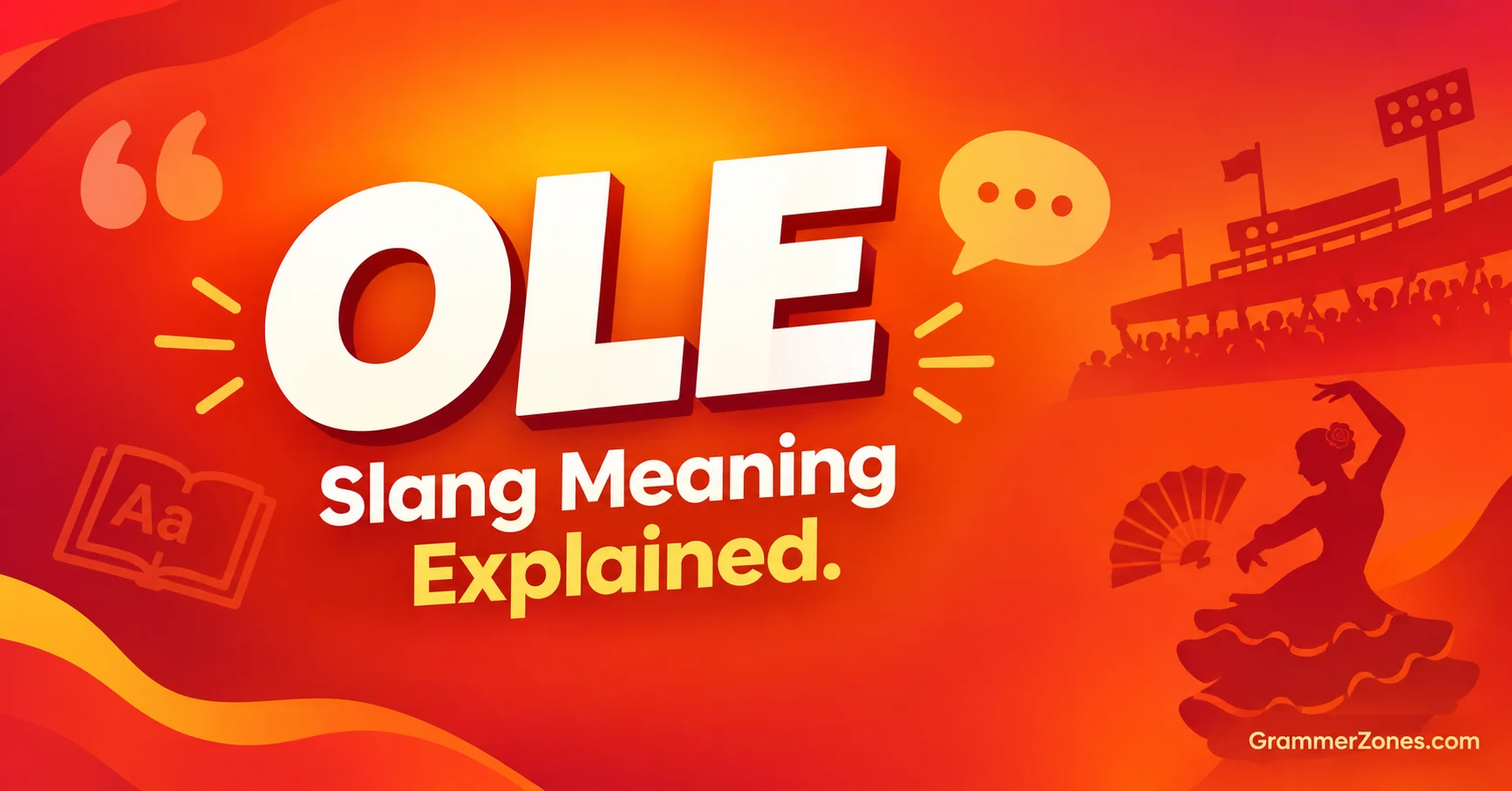
OLE is mostly an informal, phonetic spelling of old (as in my OLE man or the good OLE days), while its accented cousin OLE is a Spanish exclamation of excitement or approval shouted at bullfights, flamenco shows, and football matches. The all-caps version, OLE, is unrelated slang; it’s a tech acronym for Object Linking and Embedding.
Ever typed OLE into a search bar at 1 a.m., half-convinced you were losing your mind because the same three letters seemed to mean three completely different things depending on where you saw them? You’re not alone. One minute it’s a Spanish football chant, the next it’s your grandpa’s favorite phrase, and somewhere in between it’s an acronym buried in a software manual. That confusion is exactly why so many people search for this term; they’ve seen it in a text, a caption, a stadium chant, or a random Google result, and they just want a straight answer.
This guide breaks down every version of the word, where it comes from, how it’s used across chat apps and social media, and why context is the only thing that really decides its meaning.
Meaning & Definition
At its core, OLE has two completely separate identities, and mixing them up is the number one source of confusion online.
The first is OLE (no accent) , a pronunciation spelling of old. Linguists sometimes call this eye dialect: a way of writing a word the way it actually sounds when spoken casually, rather than how it’s formally spelled. So OLE man, OLE buddy, and OLE timer all just mean old man, old buddy, old timer spoken with a dropped consonant and a relaxed, folksy rhythm.
The second is OLE (with the accent) a Spanish interjection meaning something closer to bravo, yes, or go! It’s a shout of triumph, encouragement, or approval, most famously heard at bullfights and flamenco performances, and later adopted worldwide as a football chant when fans string together a series of accurate passes.
Then there’s OLE in capitals, which has nothing to do with either of the above. In computing, it stands for Object Linking and Embedding, a Microsoft technology that lets you embed one document type inside another (think a spreadsheet chart pasted into a Word file). In UK rail transport, OLE is shorthand for Overhead Line Equipment, the wires and structures that power electric trains.
Understanding which OLE you’re looking at is really a matter of context and intent with the same three or four letters, three unrelated meanings.
Background
The colloquial OLE (meaning old) traces back to mid-19th century English, when writers started spelling words the way working-class and rural speakers actually pronounced them. It became especially associated with Southern American English, Texan and cowboy vernacular, and later African American Vernacular English, where dropping the final d sound softened old into something warmer and more familiar-sounding OLE rather than old.
Olé, on the other hand, has Spanish roots, with some etymologists tracing it even further back to the Arabic exclamation wa-llāh (roughly, by God). It entered English usage in the early 20th century through bullfighting and flamenco culture, then crossed over into mainstream pop culture through sports soccer fans chanting olé, olé, OLE became a global shorthand for celebrating skillful play.
The acronym OLE has a much more recent, corporate background: Microsoft introduced it in 1990 as a successor to Dynamic Data Exchange (DDE), giving developers a standardized way to link and embed objects across applications like Word, Excel, and Adobe’s creative suite.
So while the word looks identical on the page, its background spans a folk dialect, a centuries-old Spanish cultural expression, and a 1990s software protocol three completely different lineages that just happen to share a spelling.
Usage in Different Contexts (Chat, Social Media, Professional Fields)
Context does almost all the heavy lifting when it comes to decoding ole. In casual chat and texting, OLE nearly always means old, used affectionately, sarcastically, or just for rhythm. Same ole, same OLE is a classic example, meaning nothing much has changed.
On social media, especially in captions and comments, you’ll see both versions battling for space. A caption like throwback to the good OLE days is nostalgia-driven slang. Meanwhile, a comment under a soccer highlight reel that just says OLE 🔥 is pure celebration with no connection to age or nostalgia at all.
In professional and technical fields, the acronym version takes over almost entirely. IT documentation, software manuals, and legacy programming discussions still reference OLE when explaining how older Windows applications share data. In UK rail and infrastructure reports, OLE refers strictly to the physical overhead power lines a world away from either slang meaning.
This is exactly the kind of ambiguous keyword that search engines and natural language processing (NLP) systems have to work hard to disambiguate. Google’s algorithm relies on surrounding words, semantic entities, and user intent signals to figure out If someone typing OLE wants slang, sports, or software which is also why a single, well-structured article covering all angles tends to rank better than one narrowly focused on just one meaning.
Meaning in Chat, WhatsApp, Instagram, TikTok
Across messaging apps, OLE behaves almost entirely as slang for old, used to add warmth or informality. On WhatsApp, you might see it in a family group chat OLE man’s birthday is coming up functioning as a term of endearment rather than a literal age reference.
On Instagram, the word splits along caption versus comment lines. Captions tend to lean toward the nostalgic, affectionate use (OLE school vibes, back to my OLE stomping grounds), while comments on football or dance content almost always use the accented OLE as a celebratory reaction, often paired with fire emojis or clapping hands.
TikTok is where the two meanings collide the most. A caption might read OLE reliable (meaning tried-and-true, dependable), while the same video’s soundtrack could be a remixed football chant using OLE as the hook. Because TikTok’s algorithm and search function both weigh captions, hashtags, and audio text heavily, creators sometimes intentionally use the ambiguous spelling to tap into multiple audiences searching different intents at once, a subtle but real example of how slang and platform algorithms interact.
In short: on chat apps, expect old. In sports or celebration content, expect olé. Hashtags rarely include the accent mark, which is part of why the confusion persists.
Meaning in Physics, Medical, and Aircraft Terminology
Here’s where it’s worth being precise rather than stretching the truth for the sake of covering every angle: OLE doesn’t have a dedicated, standalone meaning in physics, medicine, or aviation. It’s not an established term of art in any of those fields.
What does exist, and is easy to confuse with it, is the suffix -ole, which shows up constantly in chemistry and pharmacology, think pyrrole, indole, or thiazole, all five-membered ring compounds used in organic chemistry and drug naming. If you’ve ever read a medication name ending in -azOLE (like fluconazole), that’s this same suffix family at work, though it’s a naming convention rather than a slang term.
In aviation and rail engineering, the relevant term is the acronym OLE Overhead Line Equipment, the network of wires that supplies power to electric trains, most commonly referenced in UK rail infrastructure documentation rather than aircraft systems specifically.
So if you landed here expecting a physics or aerospace definition, the honest answer is that you’re likely thinking of a different acronym, or you’ve encountered the -OLE chemical suffix rather than the slang word itself.
Common Misconceptions
The biggest misconception is treating OLE and OLE as interchangeable. They’re not one is a lazy, affectionate spelling of old, and the other is a full Spanish exclamation with its own pronunciation, accent mark, and cultural weight. Dropping the accent in casual typing (which almost everyone does) is exactly why the two get tangled together online.
A second misconception is assuming OLE (the acronym) is somehow connected to the slang term. Object Linking and Embedding was named independently by Microsoft engineers and has zero etymological relationship to either the Spanish interjection or the Southern dialect spelling.
A third, more surface-level misconception is that OLE is a strictly regional or outdated term. While it does have deep roots in Southern and rural American English, it’s just as common today in memes, TikTok captions, and casual texting worldwide; it hasn’t aged out of use, it’s just shifted platforms.
Similar Terms & Alternatives
If you’re trying to convey the same warmth or nostalgia as OLE (meaning old), similar informal spellings include ol’, lil’, kinda, and all examples of eye dialect that mimic spoken pronunciation. In terms of tone, good OLE days sit alongside phrases like back in the day or the golden years.
For the celebratory olé, close alternatives include bravo, woo, let’s go, or simply a fire emoji in modern digital shorthand. In football culture specifically, OLE is functionally similar to chants like we are the champions in tone, if not in literal meaning.
For the acronym, related technical terms include COM (Component Object Model), ActiveX, and DCOM, all Microsoft technologies from the same era that served overlapping purposes in software object sharing.
How to Respond to It
If someone sends you OLE in a casual chat say, hope OLE John’s doing okay the natural response treats it exactly like old: no clarification needed, just read it as affectionate or neutral phrasing.
If you see OLE as a standalone comment or reaction, the appropriate response mirrors its energy: a celebratory reply, an emoji, or simply acknowledging the excitement. It’s not a question or a request; it’s an exclamation, so it rarely needs a direct answer.
If OLE shows up in a technical or professional context, respond factually clarify If the conversation is about legacy Windows object embedding or rail infrastructure, since getting this wrong in a work setting can cause real confusion.
Differences from Similar Words
OLE is easy to confuse with a handful of lookalikes. Olde, often seen in branding (Ye Olde Shoppe), is a mock-archaic spelling used for old-timey aesthetic effect, not actual historical English. OLE carries the accent and Spanish pronunciation, distinguishing it clearly from the dialect spelling once you know to look for the mark. And OLE in all caps signals an acronym, not a word at all; capitalization here is a genuine semantic cue, not just a stylistic choice.
Relevance in Online Conversations & Dating Apps
On dating apps and in everyday online conversation, OLE tends to show up as a personality marker rather than a literal description. A bio that says just an OLE soul looking for someone to watch bad movies with signals warmth, humor, and self-aware nostalgia it’s doing emotional work, not describing actual age.
Olé, meanwhile, occasionally pops up as a playful reaction in flirty exchanges, especially after a witty comeback or a confident move functioning almost like a verbal high-five. Because both spellings are short, expressive, and low-effort to type, they fit naturally into the fast, casual rhythm of modern messaging, where tone often matters more than technical correctness.
Conclusion
OLE turns out to be less a single word and more a small cluster of look-alikes that happen to share a spelling.
Strip away the accent and it’s a warm, informal stand-in for old. Add the accent back and it becomes a Spanish shout of triumph borrowed by football fans worldwide. Capitalize it, and it switches lanes entirely into software and rail engineering territory. None of these meanings are wrong; they’re just answering different questions, which is exactly why context, tone, and platform matter more than the letters themselves.
The next time it shows up in a caption, a chant, or a chat thread, you’ll know exactly which OLE you’re dealing with and why searching for its meaning wasn’t overthinking it at all.
Discover Other Posts!
GF Meaning: Chat, Gaming, Food, Football & Medical Uses
SP Meaning: What It Stands For in Text, Medical & Police Use
Hun Meaning Explained: Sweet, Sarcastic, or Something Else?

I’m Mason Reed, a language and communication writer at GrammerZones.com. I specialize in explaining English meanings, grammar concepts, internet slang, texting abbreviations & social media terms in a clear and practical way. My goal is to provide accurate, easy-to-understand content that helps readers confidently navigate modern language and online communication.


1 thought on “Ole Slang Meaning 🔥 In Chat, Sports & Text”