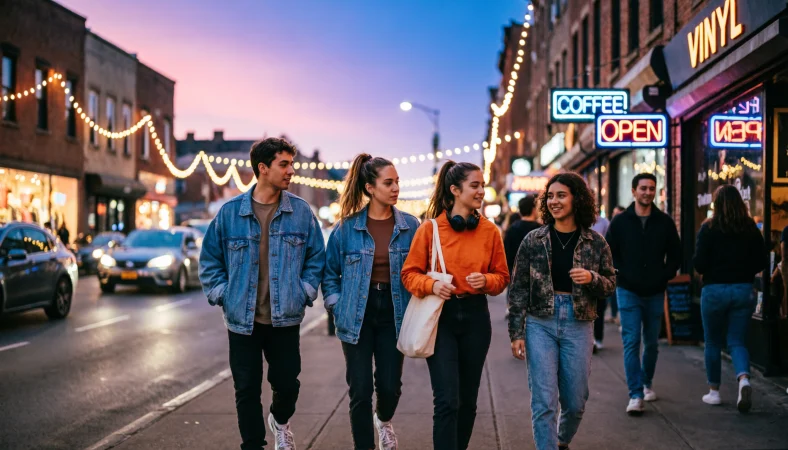
We outside means you (or your friend group) are out in public having a good time at a party, event, or just roaming the city and you’re announcing it with pride. It’s less about literal GPS coordinates and more about a feeling: we’re not sitting home tonight.
There’s something almost funny about a phrase this short causing this much confusion. Two words, no punctuation, and yet it shows up in a caption, a text, a TikTok comment section and somehow means slightly different things depending on where you see it.
That’s usually why people end up searching for it in the first place. Someone gets a text that just says we outside, or scrolls past a caption on a group photo and thinks, wait, is that a threat, an invite, or just vibes? (It’s almost always vibes.)
This piece breaks down where the phrase came from, what it actually signals in different contexts: chat, dating apps, TikTok, real conversation and how you can use it or respond to it without sounding like you just learned it five minutes ago.
What We Outside Actually Means
At the core, it’s a declaration of presence and energy: we are out, active, and living our lives in public right now. That’s it. No hidden layer, no complicated backstory.
Grammatically, it’s worth noting the phrase drops the verb are it’s not we ARE outside, it’s just we outside. That’s not sloppy grammar. It’s a feature of African American Vernacular English (AAVE), where dropping linking verbs like to be is a long-standing, structured part of how the dialect works, not an error. This same pattern shows up across tons of AAVE-rooted slang, which is part of why it feels so natural to say and so catchy to type.
Depending on where you encounter it, we outside can mean:
- We’re at a party, club, or event right now
- We’re out in the city, doing something, being seen
- We’re heading out and you’re welcome to join
- We showed up this is happening, and we’re part of it
The emphasis is almost always on the energy of being out, not the literal act of standing on a sidewalk.
Where It Came From
Verb-dropping constructions like this have existed in AAVE for generations; it’s not something that got invented for social media. What changed is the moment the phrase attached itself to.
We outside really caught fire as pandemic restrictions started lifting. After months of lockdowns, people were finally free to go to bars, concerts, cookouts, whatever and we outside became the phrase for announcing it. It wasn’t just a statement, it was a celebration. A lot of us had genuinely forgotten what it felt like to get dressed up and leave the house for fun, and this phrase captured that specific relief and excitement better than anything else did.
From there it spread the way slang always spreads now through captions, remixed audio clips, and reaction videos until it became a general-purpose hype phrase completely detached from its pandemic origins. These days, most people using it have no idea it started as a we survived lockdown flex. It’s just… what you say when you’re out.
How People Actually Use It Across Platforms
Texting and group chats. This is where the phrase does its most literal work. We outside, pull up is basically an invitation confirming the group already committed to going out and is now extending the invite to you specifically.
Instagram captions. Usually paired with a party photo, a group shot, or a night-out recap. It’s short, confident, and doesn’t need explaining to anyone already in the loop.
TikTok. This is where the phrase has almost become its own content category: nightlife clips, festival recaps, spontaneous street videos, all captioned or soundtracked with some version of we outside. Search the term and you’ll mostly find high-energy, filmed-in-public content, which tells you a lot about how the algorithm and the audience have paired the phrase with a specific visual style.
Comment sections and reaction threads. Often used as a stand-alone hype comment under someone else’s out-and-about post, basically the internet’s version of cheering someone on.
A Quick Word on Technical Fields
If you’ve seen claims floating around that we outside have some hidden meaning in physics, medicine, or aviation it doesn’t. Those fields all use the word outside in their own literal, technical ways (spatial position, temperature readings, patient status relative to a normal range), but none of that connects to this slang phrase. It’s purely cultural and conversational, and any claim otherwise is just search-engine noise, not a real usage.
Common Misunderstandings
A few things trip people up:
- It’s not always literal. You don’t have to be standing outdoors for it to apply. It’s about the vibe of being active and social.
- It’s not always about partying. Sometimes it just means running around doing errands or hanging out somewhere low-key.
- It’s not aggressive. Out of context, in a video clip or meme, it can look confrontational, but in everyday conversation it’s playful and upbeat almost all the time.
- It’s not a brand-new invention. The grammar pattern behind it has existed for a long time; the phrase just found a new spotlight.
We Outside vs. I’m Outside vs. Other Similar Phrases
These get mixed up a lot, so here’s the actual distinction:
I’m outside is singular and literal usually means someone has physically arrived somewhere and is letting you know. Classic example: texting I’m outside before a date or when picking someone up. There’s no group-energy implication here; it’s a location update, plain and simple.
We outside are collective and about energy, not arrival. It’s less I am at this specific spot and more we, as a group, are out living life.
Pull up is an invitation to join a different function entirely, since it’s asking someone to come, not announcing that you already are somewhere.
The vibes describe a mood or atmosphere rather than a location or activity.
Knowing the difference matters because using I’m outside when you mean the group hype version (or vice versa) can genuinely confuse the person reading it.
How to Respond If Someone Says It to You
Match the energy that’s really the only rule. A few natural responses:
- Say less, on my way
- Where are you?
- Wish I was there
- Just a fire emoji or let’s gooo works fine too
Overthinking a reply to a casual hype phrase is the fastest way to look like you’re not familiar with how it’s used.
Dating Apps, Texts, and What It Signals About Someone
This is where the phrase gets a little more personal. If a match’s bio says something like we outside or a girl texts it as a way of describing her weekend, it’s usually shorthand for I have a social life and I enjoy going out not a huge revelation, but it does tell you something about how someone spends their free time and what kind of plans might land well with them.
In a budding relationship or situationship, seeing we outside this weekend if you’re down is basically a low-pressure invite; it signals interest without the formality of a structured date. It’s casual by design.
Local flavor matters here too. In a city like New York, where nightlife and street culture are baked into daily life, we outside carries a slightly different weight than it might in a smaller town; it’s less of a special occasion and more of a Tuesday.
The Bigger Picture
What’s genuinely interesting about we outside is how much cultural information two words can carry. It references AAVE grammar, a specific post-pandemic emotional moment, and current social media aesthetics, all at once and most people using it today are doing so instinctively, without thinking through any of that history. That’s honestly how the best slang usually works: it gets adopted long before anyone stops to ask where it came from.
Final Thoughts
We outside aren’t complicated once you strip away the confusion. It’s a phrase about presence, energy, and being part of the moment.
If that’s a night out, a spontaneous hangout, or just letting someone know your group is on the move. It grew out of real AAVE grammar patterns and a real cultural moment (the return to public life after lockdown), and it’s stuck around because it’s short, expressive, and instantly understood by anyone plugged into the culture.
If you’re decoding a text, figuring out what someone meant on a dating app, or just trying to keep your slang current, you now know exactly what it means, where it came from, and how to use it without missing a beat.
Read More About!
Ta-Ta Meaning: Origin, Slang Uses & Modern Texting Explained
KD Meaning: Text, Gaming, Snapchat & SEO Explained
DTB Meaning Explained: Text, TikTok & Social Media

I’m Andrew West, a content writer at GrammerZones.com, specializing in high-ranking grammar blogs and modern language trends. I simplify complex grammar and decode Gen Z and Gen Alpha slang to make communication clear, relevant, and engaging.