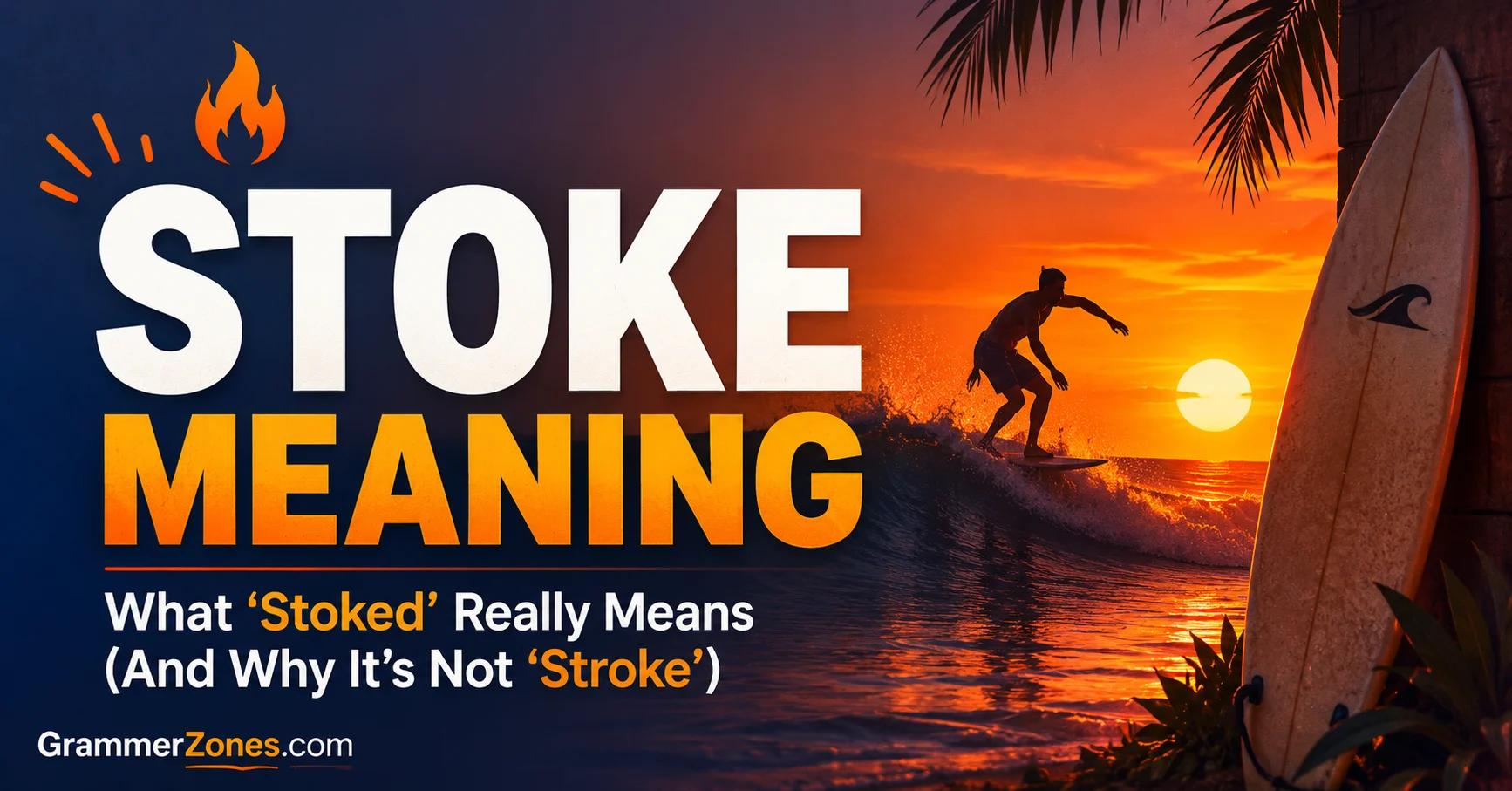
Someone texts you I’m so stoked, and you know exactly what they mean even if you’ve never once stopped to think about where that word came from. In short: stoke means excitement, hype, or pure enthusiasm, and stoked is the feeling of being genuinely thrilled about something. That’s the quick answer. The more interesting question is how a word about literally poking a fire ended up describing your reaction to good news on Instagram.
That’s the real hook here. Stoke has one foot in 17th-century fireplaces and the other in your group chat, and almost nobody searching this term realizes both are true at once. This piece walks through where the word actually comes from, how it’s used differently depending on where you see it (a text, a surf forum, a dating bio), where it gets confused with completely unrelated words like stroke, and even where Stoke shows up as a place name in British football folklore.
By the end, you’ll be able to use it correctly and explain it to someone else without sounding like you Googled it five minutes ago.
What Stoke Actually Means
Strip away the slang for a second, and stoke has a plain old dictionary meaning: to poke or stir up a fire, or to supply it with fuel. Merriam-Webster still lists that as the primary definition, alongside a figurative sense to feed or intensify something, like stoking concern or stoking sales.
The slang version grew directly out of that image. If stoking a fire means feeding it until it burns brighter, then being stoked means your enthusiasm has been fed until it’s burning hot. As Dictionary.com puts it, when a surfer says she’s stoked, the fire of her enthusiasm is burning higher. That’s a genuinely elegant bit of word evolution not an invented internet meaning, but a natural metaphorical stretch from something very old.
In everyday use, you’ll see it in three forms:
Stoke (noun) the feeling itself. There’s so much stoke in this room right now. Stoke (verb) to build up that feeling in someone, or in a fire. The trailer really stoked my excitement for the movie. Stoked (adjective) the state of being excited. I’m stoked for the weekend.
One quick but important clarification, because it trips people up constantly: stoke and stalking are not related in any way. They land close together in spelling and sometimes in autocorrect, but stalking refers to unwanted, persistent surveillance of a person, a completely different word with a completely different history. If you typed one and meant the other, no judgment; it happens more than you’d think.
Where the Word Comes From
The literal English sense of stoke poking or feeding a fire has old Germanic roots tied to the idea of prodding or spurring something on. But the specific slang usage most people search for today has a more traceable, more colorful history.
According to the Encyclopedia of Surfing, stoke as an expression of excitement is an English adaptation of a 17th-century Dutch word, stok, originally used to describe rearranging logs in a fireplace to bring the flames back up. California surfers picked up the word in the early-to-mid 1950s, and unlike a lot of slang from that era it never really faded. It just kept spreading.
From surfing, it moved naturally into skateboarding and snowboarding, where the same rush applied: that specific high of nailing a trick, catching a perfect line, or just being deeply into a sport most people don’t fully understand from the outside. Eventually it broke out of action sports altogether and became general youth and internet slang, used by people who’ve never set foot on a board.
So when you search for the meaning of stoke tied to surf culture specifically, you’re not imagining a connection, you’re tracing the word back to exactly where it took off.
How People Actually Use It Today
Context changes the weight of the word more than you’d expect.
In casual conversation, it’s low-stakes and warm: I’m stoked for the weekend just means you’re looking forward to something. In workplaces or team settings, it shifts slightly. Let’s stoke some momentum on this launch and use the word more figuratively, closer to its original fire-feeding sense: building energy, not just feeling it. Brands lean on it too, especially ones trying to sound energetic or outdoorsy without sounding corporate event promos, product drops, fitness marketing.
On WhatsApp, Instagram, and TikTok
On messaging apps, stoked almost always means exactly what it sounds like: no hidden layers. I’m stoked for tomorrow! It is straightforward excitement about a plan.
On Instagram, you’ll often see it in captions like so stoked to finally share this which connects to the phrase people search as sharing the stoke: the idea of spreading your excitement outward so followers feel a bit of it too, not literally handing anything over.
TikTok has pushed the word further into shorthand. You’ll see full stoke mode or just full stoke used to describe being completely locked into something: a trip, a hobby, a niche interest with zero self-consciousness about it. Related phrases like keep the stoke and own the stoke show up a lot in outdoor and creator communities: keeping the stoke means holding onto your enthusiasm over time instead of letting it fizzle, while owning the stoke means being unapologetically excited instead of playing it cool.
Where Stoke Gets Confused With Something Else Entirely
This is where a lot of search traffic actually comes from, and it’s worth addressing directly instead of glossing over it.
Stoke vs. stroke (medical): There is no medical definition of stoke. If you searched for one, you were almost certainly thinking of stroke a serious medical event involving disrupted blood flow to the brain. The words are close enough in spelling to cause real confusion, especially in health-related searches, so it’s worth being precise: stoke is about excitement, stroke is a medical emergency, and mixing them up matters.
Stokes (physics): In physics and engineering, stokes with an s, and capitalized as a unit measures kinematic viscosity. It’s named after the 19th-century physicist Sir George Gabriel Stokes. This has nothing to do with slang and everything to do with fluid dynamics; it just happens to share a name.
Stoke as a place: Stoke also shows up as a place name across the UK most famously Stoke-on-Trent, home to Stoke City Football Club. This has produced one of English football’s most enduring in-jokes: pundits and fans have long asked whether a flashy, technically gifted player could do it on a cold, wet night in Stoke, a phrase referencing the club’s historically physical, no-frills style of play. It’s been referenced by everyone from football commentators to Andy Murray, and it’s a good example of how Stoke the place and stoke the slang word are two entirely separate things that only overlap by spelling.
Clearing up these overlaps isn’t just trivia, it’s usually the actual reason someone typed the search in the first place.
Similar Words, and How Stoke Is Different
Stoked sits in the same general territory as hyped, amped, psyched, pumped, fired up, and thrilled but it doesn’t feel identical to any of them.
Hype often carries a whiff of promotion or exaggeration, something manufactured rather than felt. Excited is neutral and works anywhere, but it’s also generic and doesn’t carry a personality. Stoked sits somewhere more specific: relaxed, genuine, a little bit cool without trying to be, carrying the outdoor-adventure DNA it inherited from surf culture even when it’s used to describe something as mundane as a coffee order.
If someone tells you they’re stoked, the natural response matches that energy rather than escalating it: that’s awesome, I’m stoked for you lands better than an overly formal I’m delighted to hear that. It’s a casual word, and it wants a casual reply.
Why It Shows Up So Much in Dating Apps and Online Chats
There’s a reason stoked is everywhere on dating profiles and in early-stage texting: it signals interest without sounding intense. I’m stoked to meet you as relaxed and genuine, where I’m SO excited!! can come across as trying too hard.
It’s also a go-to word in dating bios who are always stoked for a new adventure is shorthand for an easygoing, up-for-anything personality, which is exactly the vibe a lot of people are trying to project in twenty words or less. Understanding that tone is arguably more useful than the dictionary definition, because it’s the difference between using the word naturally and using it in a way that feels slightly off.
Quick Answers
Is stoked the same as excited?
Basically yes, but with more personality. Excited is neutral; stoked carries a relaxed, outdoorsy, slightly cooler tone borrowed from surf culture.
Does stoke have anything to do with stalking?
No. They’re unrelated words that only look similar in text.
Is stoke new slang?
No it dates back to 1950s California surf culture, with roots in a 17th-century Dutch word for stirring up a fire. It’s decades old, not internet-invented.
Why does stoke sometimes get searched with medical or stroke?
Because the spellings are close and autocorrect or quick typing blurs them. Stoke has no medical meaning; stroke does, and it’s a serious one.
What does full stoke mean?
Being completely, unreservedly excited or invested in something commonly used on TikTok and in outdoor/adventure communities.
The Bottom Line
Stoke is one of those rare slang words that actually earns its staying power. It didn’t get invented for social media; it was borrowed from the literal act of building up a fire, picked up by 1950s surfers to describe a very specific kind of joy, and then carried into skate parks, group chats, Instagram captions, and dating bios without ever really losing its original warmth.
Knowing the difference between being stoked and being stalked (please, never confuse those), or between the slang word and the unrelated physics unit named after a 19th-century scientist, isn’t just trivia it’s the difference between using the word with confidence and using it while quietly hoping you’ve got it right.
Now you do. So next time someone says they’re stoked, or your feed is full of full stroke captions, you’ll know exactly what’s being fed and it isn’t a fire anymore.
Discover More About
Slat Slang Meaning Decoded: Why This Word Confuses Everyone
Brah Meaning Explained: Origin, Usage & What It Really Says
What Does Geekin Mean? The Real Definition Behind the Slang

I’m Andrew West, a content writer at GrammerZones.com, specializing in high-ranking grammar blogs and modern language trends. I simplify complex grammar and decode Gen Z and Gen Alpha slang to make communication clear, relevant, and engaging.