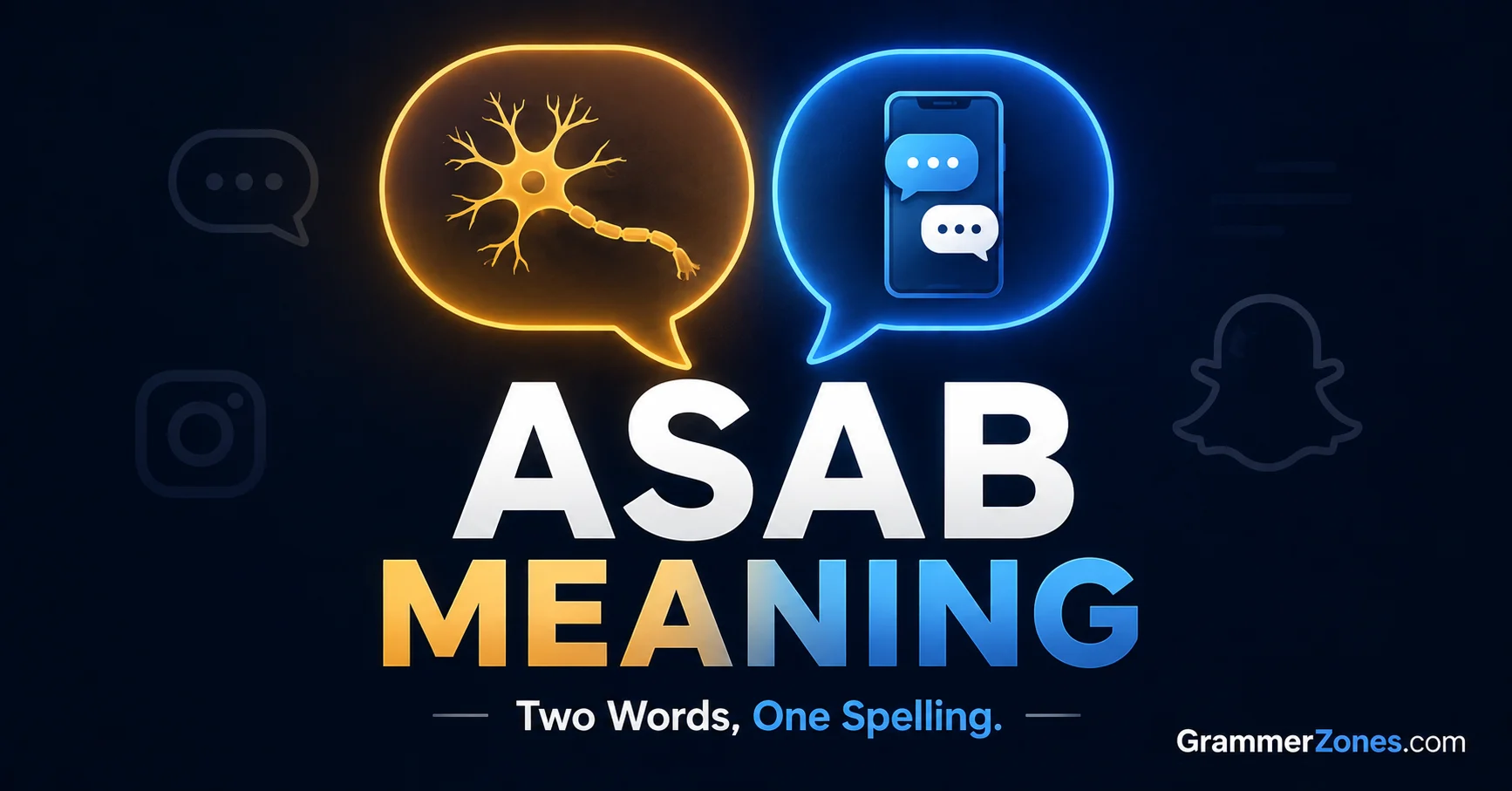
Someone sends you “asab” in a chat, or you spot ASAB in an Instagram bio, and suddenly you’re not sure if you just witnessed an insult, a joke, or a personal disclosure. Short answer: lowercase “asab” is a real Urdu and Arabic word (عصب) meaning “nerve,” used casually across South Asia to describe a fraying temper the same way English speakers say someone’s “nerves are shot.”
The capitalized acronym ASAB is a completely different, unrelated internet term with its own split identity: a slang intensifier on Urban Dictionary, and, in medical and LGBTQ+ spaces, shorthand for “Assigned Sex At Birth.”
Two words. Same four letters. Almost nobody explains that they’re not actually the same thing which is exactly why this term keeps sending people to Google confused rather than informed. This guide sorts out which meaning applies where, so a stray comment or caption doesn’t send you down a research rabbit hole next time.
A quick honesty note before we go further: slang meanings like this one are crowd-sourced and shifted by community, age group, and platform. What follows reflects how the term is documented in language references and how it’s actually used across chat apps and social platforms, not a single, permanently fixed definition.
What Asab Actually Means
Start with the word on its own, no acronym attached. In Urdu, Arabic, Hindi, and Punjabi, عصب (asab) translates literally to “nerve” or “nerves.” It’s not slang in its origin, it’s a standard word, the same one used in anatomy textbooks and doctor’s notes across the region.
The colloquial layer comes from a very human linguistic habit: borrowing a body-part word to describe an emotional state. English does this constantly “get on my nerves,” “a nervous wreck,” “nerves of steel.” Urdu and Arabic speakers do the same thing with asab. Say someone’s asab kharab ho gaya (“their asab went bad”) and you’re describing a temper snapping, not a medical event. It sits in the same emotional territory as ghussa (anger) and chidhna (getting irritated), though it leans slightly more toward the physical sensation of tension than the emotion itself, closer to “on edge” than “furious.”
Then there’s the capitalized version, ASAB, which has nothing to do with any of this. It’s an English-language internet acronym, and like most crowd-sourced slang, it doesn’t have one owner or one fixed meaning. Urban Dictionary’s most-upvoted entry treats it as a casual intensifier used roughly the way people use “so much” or “no cap” for emphasis. A separate, equally common thread of usage ties it to “Assigned Sex At Birth,” a term from medical and gender-identity contexts describing the sex recorded on someone’s birth certificate, distinct from gender identity itself.
So the real answer to “what does asab mean” isn’t a single sentence, it’s “check the capitalization, then check the context.”
Where the Word Comes From
The Arabic root ع-ص-ب carries a cluster of related ideas: binding, tension, nerves. It’s the same root behind the Arabic word for headband and for the nervous system itself tension and binding aren’t a coincidence there. As the word moved through Persian and into Urdu, Hindi, and Punjabi over centuries of shared vocabulary, it kept its clinical meaning intact while quietly picking up the emotional shorthand that’s common today.
That dual life, a real anatomical term that also does duty as an everyday mood word is why searches for this term return such a mixed bag of results: language dictionaries, medical glossaries, and slang explainers all have a legitimate claim on it.
The English ASAB is a much newer and entirely separate story. It’s a product of meme culture and crowd-edited slang dictionaries, where an acronym’s meaning gets decided less by etymology and more by whichever definition gets the most upvotes in a given month. There’s no shared linguistic root connecting it to the Urdu/Arabic word; the resemblance is coincidental, a quirk of the Latin alphabet rather than a real connection.
How It Plays Out by Platform
The meaning genuinely shifts depending on where you encounter it, and language is usually the fastest tell.
| Where you see it | Most likely meaning | What to watch for |
| WhatsApp / everyday chat | Urdu/Arabic “nerve, temper” sense | Roman Urdu, Hindi, or Punjabi phrasing nearby |
| Instagram captions & comments | ASAB slang intensifier | English-only text, joke or meme tone |
| Instagram bios | “Assigned Sex At Birth” | Identity-related context, pronouns nearby |
| Snapchat | ASAB slang intensifier | Youth-skewed, meme-driven usage |
| TikTok | ASAB, used loosely for emphasis or rhythm | Caption humor, sound-based trends |
| Medical or clinical text | Literal “nerve/nervous system” | South Asian healthcare or pharmacy context |
The pattern worth remembering: if the sentence around it is in Roman Urdu, Hindi, or Punjabi, you’re almost certainly looking at the temper/nerve meaning. If it’s plain English on a social platform, it’s the acronym and if that acronym leans toward joke-intensifier or identity-term usually comes down to if the post is about something funny or something personal.
Common Mix-Ups Worth Clearing Up
The single biggest misconception is treating “asab” and “ASAB” as one word. They’re not one that has centuries of linguistic history behind it, the other is a few years old and internet-native.
A second mix-up: assuming the “gender” association means the word itself is some kind of identity label. It isn’t. The connection only exists through one specific acronym reading “Assigned Sex At Birth” and even that’s one of several competing definitions crowd-sourced on Urban Dictionary, not a universally agreed meaning. Treating any single slang dictionary entry as gospel is a mistake generally, and it’s especially worth avoiding here, since the entries genuinely disagree with each other.
One more: there’s no credible evidence of “asab” carrying a distinct meaning in physics or aviation terminology. If you’ve seen a page claiming otherwise, it’s most likely an acronym-matching tool guessing rather than a documented usage worth being skeptical of.
Nearby Words That Help Place the Meaning
A few related terms help anchor where “asab” sits linguistically. On the Urdu/Arabic side: ghussa (anger), chidhna (to get irritated), and plain English “temper,” “frustration,” and “nerves” all overlap with it to varying degrees though none is a perfect synonym. On the English acronym side, ASAB sits near lookalikes like AFAB and AMAB (Assigned Female/Male At Birth), which share the same medical origin but aren’t interchangeable with the slang-intensifier reading of ASAB.
How to Respond, Depending on Which One You’ve Got
If someone’s using the Urdu/Arabic sense venting that their asab is “kharab” or “garam” this isn’t a term that needs a clever reply. It’s closer to hearing “I’m stressed” than an insult aimed at anyone. Acknowledging the frustration or asking what happened lands better than trying to match the energy with slang of your own.
If it’s the English acronym in a caption or comment, read the tone before responding. Joke-context posts don’t need a serious reply. If it shows up in a bio or a more personal post referencing “Assigned Sex At Birth,” the respectful move is the same one that applies to any identity-related disclosure: take it at face value, and don’t turn someone sharing information about themselves into a debate they didn’t ask for.
Why This Shows Up on Dating Apps and in DMs
Two very different situations tend to surface this word in dating-app and DM contexts. Someone casually mentioning their asab being “tested” after a rough day is small talk with no deeper meaning, just a mood update. A profile referencing the acronym in its “Assigned Sex At Birth” sense is a different situation entirely: that’s someone sharing identity-relevant information, usually because it affects how they want to be understood or addressed. Skimming past it or misreading it as a joke is the most common way people accidentally come across as dismissive of something the other person considered worth stating plainly.
Quick Answers (FAQ)
What does asab mean in English?
Roughly “nerve” or “nerves” used both literally (anatomy) and colloquially (temper, frustration), depending on context.
What does asab mean on Instagram?
Usually the capitalized acronym ASAB, which functions either as a casual slang intensifier or, in identity-focused bios, as shorthand for “Assigned Sex At Birth.”
What does asab mean on Snapchat?
Typically the same acronym usage seen on TikTok and Instagram is a casual, meme-driven intensifier rather than the Urdu/Arabic word.
Is asab an insult?
Not inherently. The Urdu/Arabic sense describes a mood or temper, not an attack on someone else. The English acronym’s meanings are contextual joke, emphasis, or identity term, none of which are insults by default.
Is asab meaning related to gender identity?
Only through one specific reading of the capitalized acronym (“Assigned Sex At Birth”). The lowercase Urdu/Arabic word has no connection to gender at all.
Conclusion: Context Decides Everything
There’s no single correct answer to “what does asab mean” and any page claiming otherwise is oversimplifying a word that genuinely carries two separate identities. In lowercase, it’s a real word with real linguistic roots: nerve, temper, the physical edge of frustration, grounded in Urdu and Arabic going back centuries.
Capitalized, ASAB is a much younger internet acronym, split between a lighthearted slang intensifier and a specific, respectful medical/identity term. Neither version is wrong. The only real skill here is pattern-recognition, noticing the language, the platform, and the tone around it and now that you know what to look for, the next time this word lands in your inbox, you’ll read it correctly the first time.
Discover More About
FFR Mean? Slang, TikTok, Cardiology & Finance Explained
DPWM? Don’t Play With Me Meaning in Texting & TikTok
Wan Slang Meaning Explained: From Texting to WAN Networking

I’m Andrew West, a content writer at GrammerZones.com, specializing in high-ranking grammar blogs and modern language trends. I simplify complex grammar and decode Gen Z and Gen Alpha slang to make communication clear, relevant, and engaging.